

Terrain and mobility
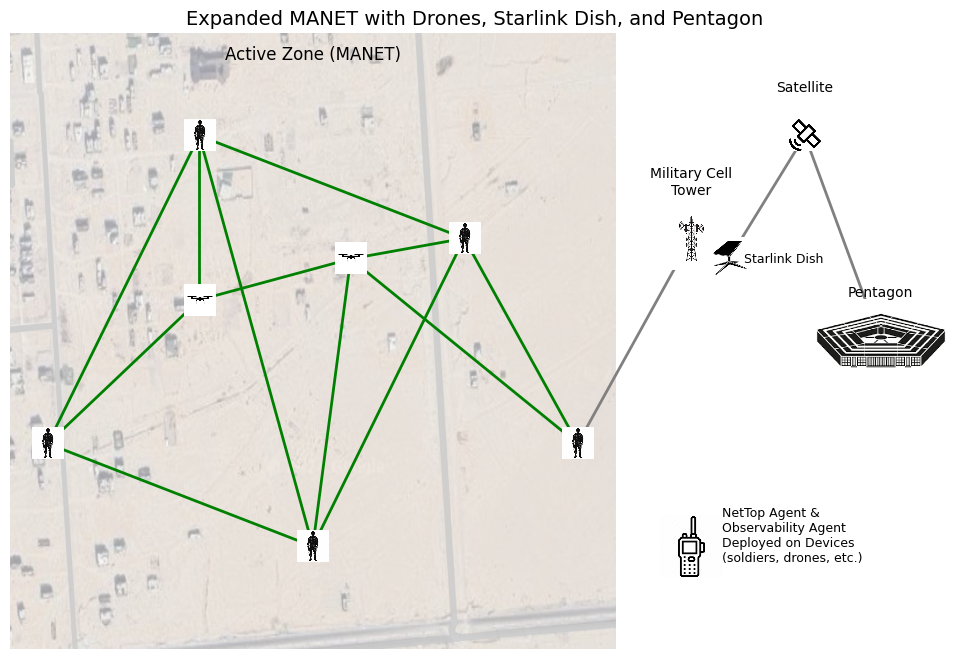
DBG targets contested, mobile, terrain-constrained missions where line-of-sight changes, blocked paths, and shifting topology can break assumptions quickly.
Project Microsite
Training predictive intelligent networking agents for contested mobile ad hoc networks.
DBG trains Predictive Intelligent Networking (PIN) agents to help mobile ad hoc networks adapt proactively to mobility, terrain, and interference. It combines adversarial scenario generation, a 3D digital twin, and RF-grounded validation to test and improve decisions before deployment.

The Challenge
DBG is motivated by mobile, contested, terrain-constrained missions where reactive heuristics fail to keep pace with rapid link changes and adversarial pressure.
DBG targets contested, mobile, terrain-constrained missions where line-of-sight changes, blocked paths, and shifting topology can break assumptions quickly.
The networking problem is shaped by jamming, spoofing, spectral contention, and uncertain operational state rather than a stable, fully observed environment.
The system must respect relay budgets, limited power, mission routing plans, and the practical requirement to adapt without changing waveform firmware.
How DBG Works
Dynamic Belief Games is the training and decision framework. PIN agents are the learned networking agents. DBG Gym is the digital twin used to train, test, and compare policies under controlled but realistic variation.
Agents form uncertainty-aware beliefs from heterogeneous observations about terrain, structure, mobility, spectrum, cyber conditions, and mission-relevant objects.
Dynamic Belief Games generates adversarial training scenarios inside a controlled digital twin so agents can learn under realistic, high-variance conditions.
PIN agents learn policies for topology, routing, queueing, prioritization, and decision support while explicitly managing downside risk.


DBG Gym
DBG Gym creates realistic terrain, materials, mobility, and traffic conditions while exposing the system through multiple views and scenario controls that support repeatable experimentation.
Validation
The project is not positioned as simulation only. The validation layer is intended to compare digital-twin assumptions against field measurements and testbed-informed radio behavior.
Demonstrated Capability
DBG Gym's first demonstration compares two platoon routes through a single urban mission envelope. Both routes share the same start and end sectors, the same mission legs, and the same formation-spacing rules; only the route geometry differs. Coverage, outage, and path loss are measured per node and per route.
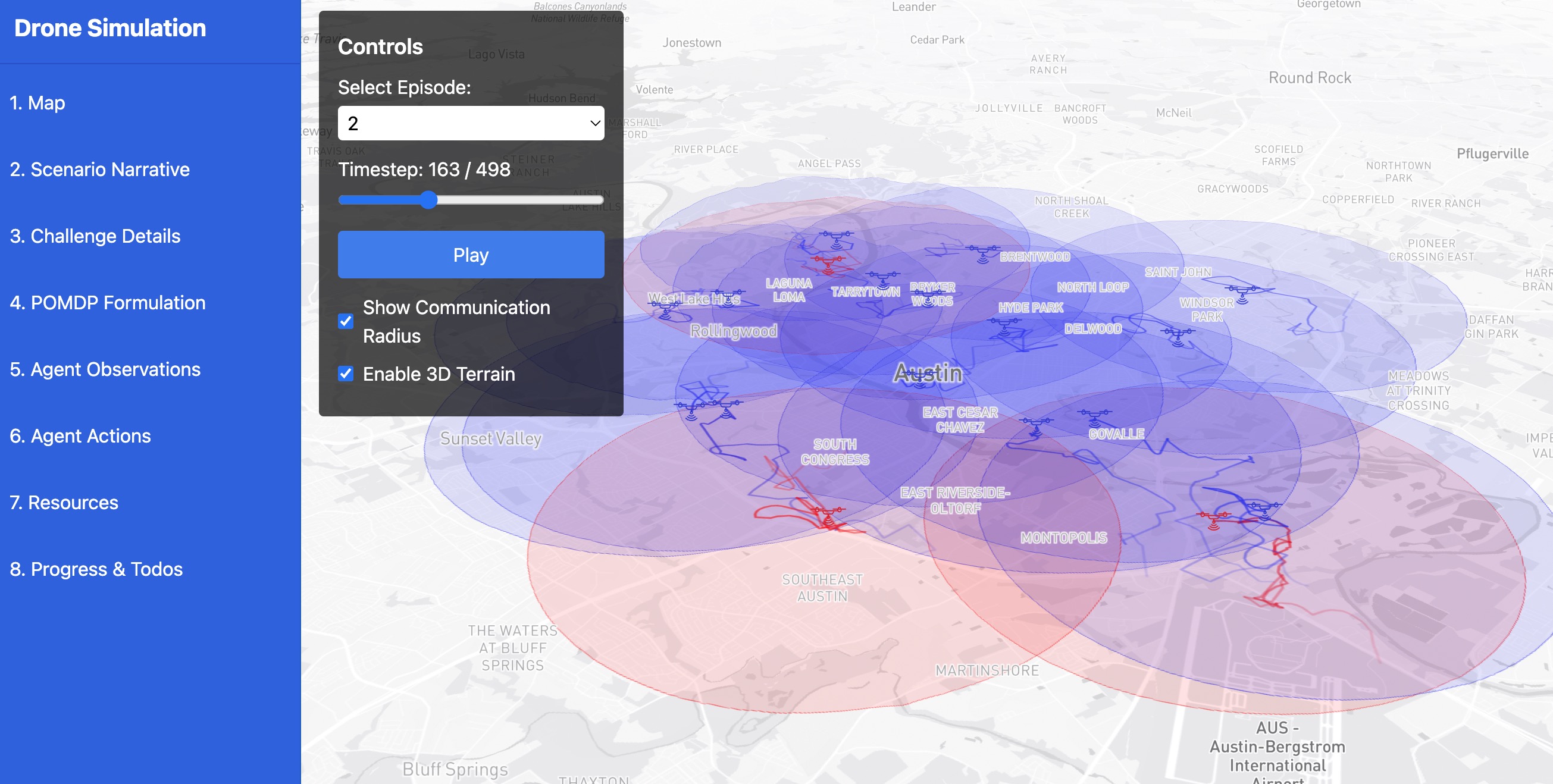
Coordinated routes — synced between buildings — sustained higher uptime than staggered, dispersed routes. Staggered routes showed a large coverage dip around a central obstruction; coordinated routes avoided it. DBG predicts and suggests such routes to maximize uptime under the same mission envelope.
Resources
The project archive holds the earlier project-page text while the microsite is being developed. For research opportunities or technical conversations, reach the project leads directly.
Reference the earlier project-page text while the new microsite is being developed.
Open archiveLead research scientist and main technical contact for current DBG work.
Email RyanPrincipal investigator for the project and broader research direction.
Email ChandrajitTeam and Contact
Internal Workstreams
These internal pages are intended for active collaborators reviewing implementation, visualization, validation, and current engineering progress. They are hidden behind a lightweight password prompt for convenience only, not strong access control.
Locked internal page
Radio simulation, PIN control overlays, SDR and AR integration, cyber-autonomy baselines, and cross-repo engineering work.
Enter protected pageLocked internal page
3D simulation, digital-twin views, terrain/material controls, and interactive scenario visualization.
Enter protected page