

Yi Wang1, Chandrajit Bajaj1,2
1Oden Institute, The University of Texas at Austin
2Department of Computer Science, The University of Texas at Austin
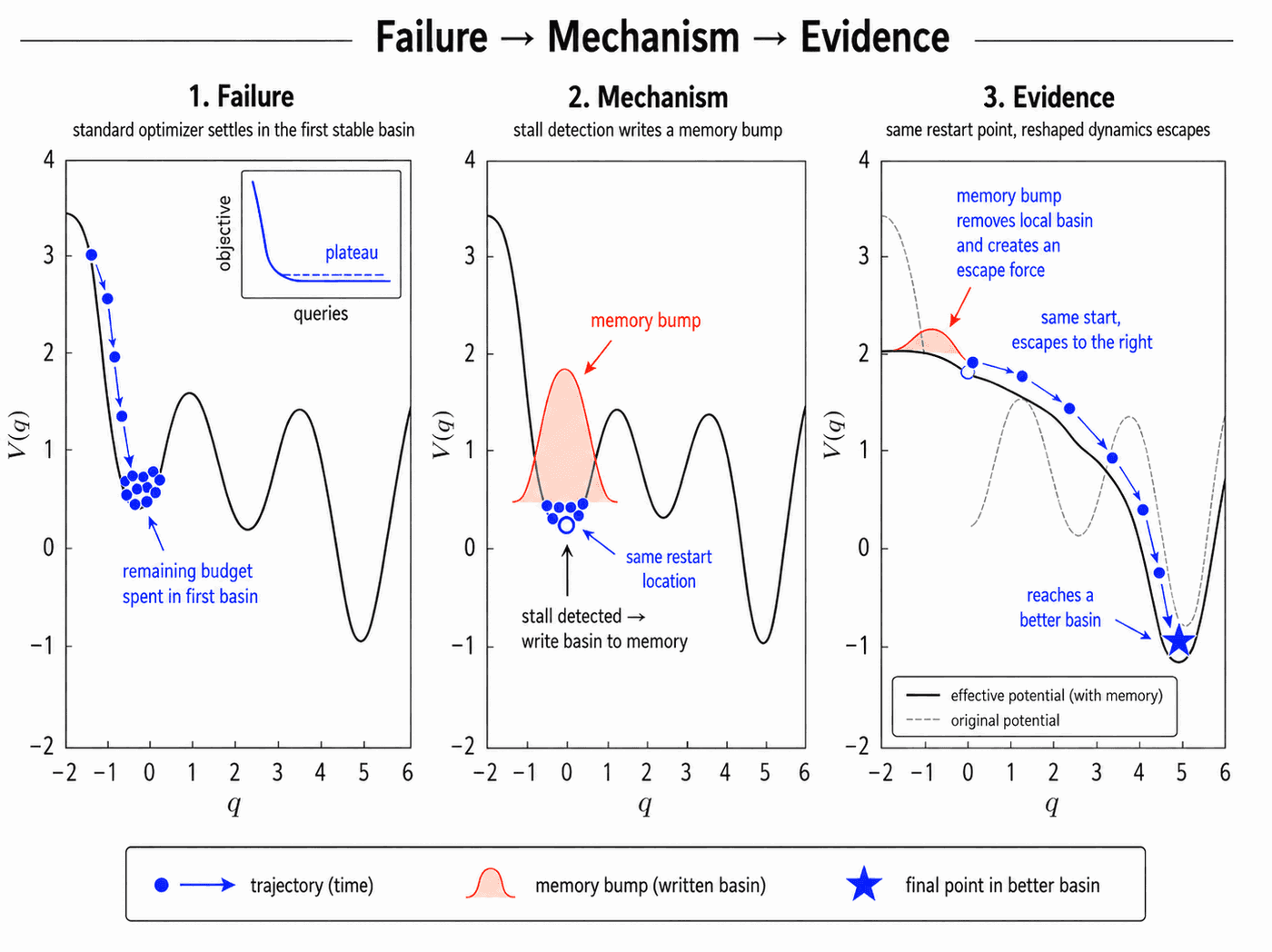
Failure → Mechanism → Evidence. A local descent method may terminate at the first stable critical point encountered from a short-sighted trajectory. SHAPE records such events in memory and uses the resulting shaped energy to discourage repeated refinement of already explored basins.
TL;DR
Fixed-budget nonconvex optimization can fail not because local descent is unstable, but because it is too stable.
After reaching a nearby stationary point, an optimizer may spend the remaining evaluations refining an uninformative local minimum. We formulate this failure mode as a control problem over optimizer dynamics, where the learner must decide when to descend, when to exploit a promising basin, and when stagnation should trigger movement elsewhere.
The Failure Mode
Descent update rules are provably stable and find the desired global minimum when the objective is convex or strongly convex. But that guarantee hides a central difficulty of nonconvex optimization under a limited budget: local descent can be too stable. Once the update reaches a nearby attractive critical point, the remaining evaluations may be spent refining a basin that is irrelevant to the best solution available under the same budget.
A fixed gradient-descent scheme is not able to decide when local descent is useful, when momentum should be dissipated, when a stable basin should be recorded, and when the next stage should be redirected elsewhere. Classical adaptive optimizers — momentum, NAG, RMSProp, Adam, and related variance-reduction schemes — provide important first-order mechanisms, but their deployment-time update laws are still largely fixed.
SHAPE: Structured Hamiltonian Adaptive Port Evaluation
SHAPE lifts the optimizer state from to . The momentum is a covector conjugate to , so the optimizer evolves in a phase space rather than by a primal update alone. At event stage , memory and a local anchor define a shaped potential
with local Hamiltonian . The memory term summarizes previously visited basins, the quadratic term gives a local stage anchor, and the optional barrier term discourages repeated refinement of excluded regions.
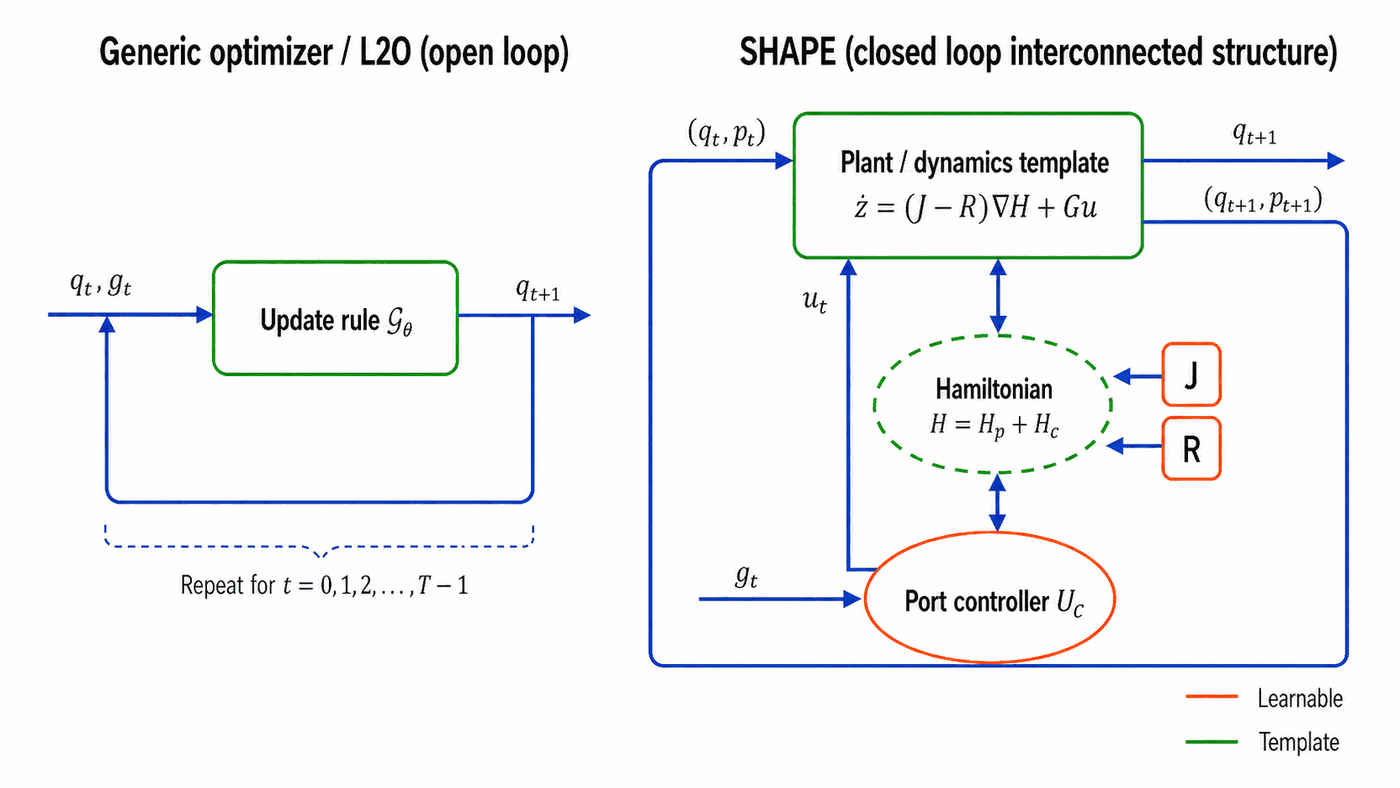
Open loop versus closed loop. A generic learned optimizer maps local oracle information directly to the next iterate, whereas SHAPE implements a closed-loop port-Hamiltonian interconnection. The plant state evolves under the shaped Hamiltonian; the learned controller selects the structured operator, damping/interconnection gains, and bounded port input.
Two time scales. Within a stage, the frozen shaped Hamiltonian induces dissipative phase-space transport. Across stages, an event interface updates memory, mode, anchor, and budget. This differs from an open-loop learned optimizer : SHAPE couples a plant and controller through power-conjugate ports, so the learned update acts through a structured port channel rather than through an unconstrained coordinate update. The design preserves a passivity-compatible structure while allowing the same trained policy to use clean, stochastic, or estimated gradient inputs.
Contributions
- Event-triggered formulation. Fixed-budget nonconvex optimization as a task-family minima hunter on , with a unified shaped potential and an explicit split between shaping input, port input, and damping injection.
- A practical optimizer. SHAPE for clean-gradient, stochastic-gradient, and value-only oracle inputs, using the local port-Hamiltonian template with energy-balance diagnostics for noise, port work, and discretization defects.
- Finite-budget analysis. Supporting results on frozen-stage hypocoercive contraction, discrete contraction, hybrid memory-assisted improvement, and stochastic-oracle energy perturbations, evaluated on synthetic, physics-based, and control-oriented nonconvex task families.
Results
All learned parameters are frozen at test time and evaluated zero-shot on held-out tasks; classical baselines are run under matched oracle-query budgets. For each family, the baseline row is the strongest classical baseline selected by average BestGap.
| Family | Dim. | Method | Final gap ↓ | Best gap ↓ | Hit rate ↑ |
|---|---|---|---|---|---|
| Multi-well | 1 | SHAPE / full | 0.987 | 0.477 | 0.602 |
| Multi-well | 1 | Momentum | 1.290 | 1.115 | 0.300 |
| Ackley | 2, 20, 100, 500 | SHAPE / full | 0.679 | 0.323 | 0.486 |
| Ackley | 2, 20, 100, 500 | NAG | 1.71 | 1.31 | 0.389 |
| Lévy | 2, 20, 100, 500 | SHAPE / full | 0.074 | 0.0427 | 0.227 |
| Lévy | 2, 20, 100, 500 | RMSProp | 0.202 | 0.202 | 0.533 |
| Lennard–Jones | 6, 18 | SHAPE / full | 0.254 | 0.113 | 0.190 |
| Lennard–Jones | 6, 18 | RMSProp | 0.519 | 0.519 | 0.000 |
| Phase retrieval | 8, 32 | SHAPE / full | 0.00601 | 0.00351 | 0.631 |
| Phase retrieval | 8, 32 | NAG | 0.040 | 0.040 | 0.000 |
| Control trajopt | 8, 32 | SHAPE / full | 2.49 | 0.106 | 0.316 |
| Control trajopt | 8, 32 | RMSProp | 1.33 | 1.33 | 0.002 |
SHAPE improves BestGap and hit rate on the multi-well study, Ackley, low-to-moderate Lévy summaries, Lennard–Jones, phase retrieval, and the control best-so-far metric. The same table exposes two limitations honestly: coordinate-adaptive baselines remain very strong on high-dimensional separable analytic functions (most visibly Rastrigin, where RMSProp dominates), and in control trajectory optimization SHAPE attains a better best-so-far objective but not the best terminal objective — the controller discovers good regions before fully stabilizing to them within the fixed budget.
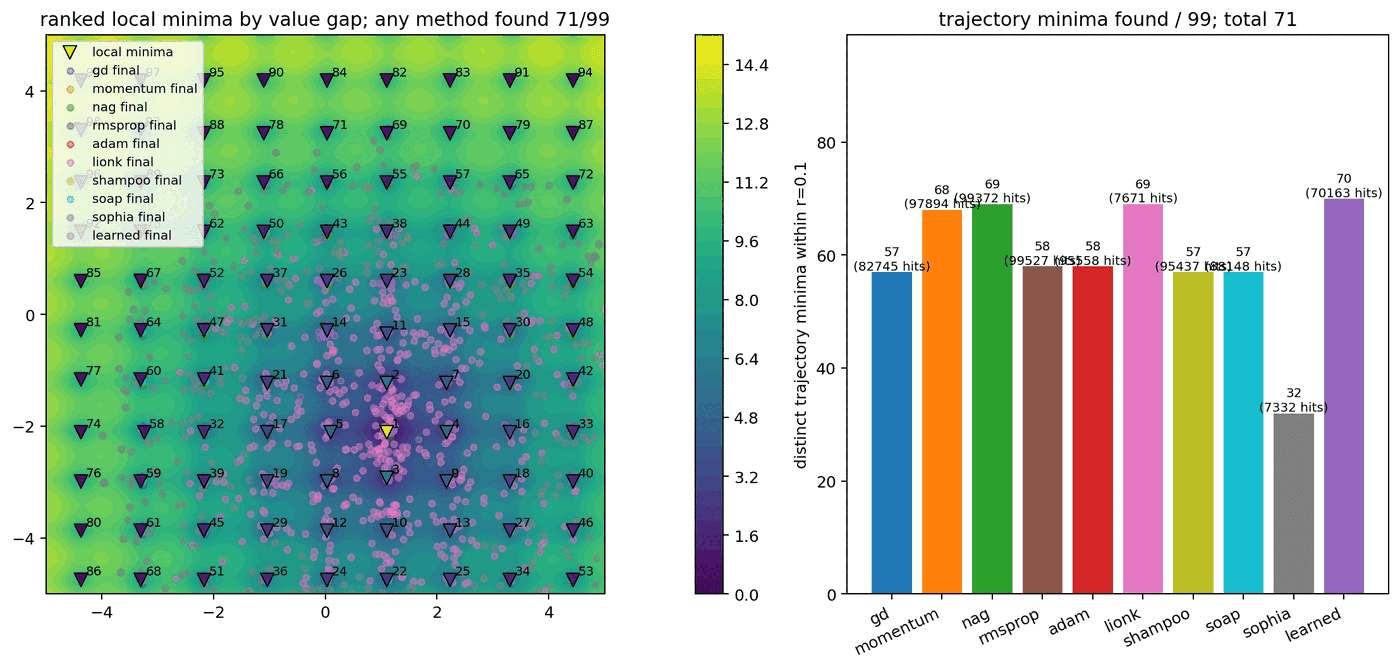
Minima finding over 512 random initializations. Left: ranked local minima by value gap on one sampled Ackley task instance. Right: distinct trajectory minima found by each optimizer. SHAPE traverses the landscape so that each search trajectory is more informative than fixed gradient-descent methods.
Budget ablation. Holding the total per-task rollout budget fixed at , SHAPE remains competitive across all settings and improves as evaluation covers more tasks or allocates longer per-particle rollouts: best-seen gap falls from to below , while trajectory hit rate rises from 40.0% to 72.7%.
Controller ablation. Removing the local interconnected controller substantially worsens the best-seen gap in every reported dimension (Ackley : 0.794 → 2.865; : 0.001 → 0.685), indicating that the learned controller is not merely adding parameters but contributes to the navigation policy.
Abstract
Fixed-budget nonconvex optimization can fail not because local descent is unstable, but because it is too stable: after reaching a nearby stationary point, an optimizer may spend the remaining evaluations refining an uninformative local minimum. We formulate this failure mode as a control problem over optimizer dynamics, where the learner must decide when to descend, when to exploit a promising basin, and when stagnation should trigger movement elsewhere.
We introduce SHAPE, a structured adaptive port-Hamiltonian task-family optimizer for event-triggered minima hunting under local information. Starting from gradient-descent dynamics, SHAPE lifts optimization to an augmented phase space , where the primal state represents the candidate solution, the cotangent variable carries directional sensitivity, and a controller provides processed information from the current gradient oracle. Within each stage, a learned Hamiltonian vector field induces structured local descent; across stages, a fixed event clock updates ports and memory when local equilibria are detected. This design preserves a passivity-compatible structure while allowing the same trained policy to use clean, stochastic, or estimated gradient inputs.
Experiments on fixed-budget nonconvex optimization tasks show that SHAPE improves best-so-far performance compared with fixed-policy optimizers. These results suggest that adaptive Hamiltonian energy shaping provides a principled mechanism for balancing descent, exploration, and budget allocation in difficult optimization landscapes.
Limitations
In high-dimensional spaces, online gradient-descent variants are often preferred and have proved practically effective for training overparameterized models. Although the method supports compressed memory independently of the ambient parameter dimension, information loss — especially validation of vector-field topology — is intractable in the current implementation. How to decompose high-dimensional state spaces and perform efficient updates remains an open research question, as does incorporating uncertainty quantification into the controller.
BibTeX
@article{wang2026descent,
  title   = {When Descent Is Too Stable: Event-Triggered Hamiltonian Learning to Optimize},
  author  = {Wang, Yi and Bajaj, Chandrajit},
  journal = {arXiv preprint arXiv:2605.06868},
  year    = {2026},
  url     = {https://arxiv.org/abs/2605.06868}
}
People
- Yi Wang
- Chandrajit Bajaj