

ICLR 2026
Aditya Sai Ellendula, Yi Wang, Minh Nguyen, Chandrajit Bajaj
Department of Computer Science & Oden Institute, University of Texas at Austin
TL;DR
Navigate unknown environments by learning energy landscapes, not reward functions.
GRL-SNAM casts simultaneous navigation and mapping as learning a scenario-to-Hamiltonian map. Instead of training a black-box policy via Bellman backups, we learn a structured energy function whose forward flow generates safe, efficient trajectories enabling a deformable robot to squeeze through cluttered passages while mapping only ~10% of the workspace.
Motivation: Why Standard RL Fails at Navigation
Standard deep RL controllers learn a frozen behavior that breaks when local obstacle geometry changes. Three structural limitations are particularly acute: (1) sample efficiency -- continuous control demands massive data collection, (2) generalization -- black-box policies memorize training environments, and (3) temporal scale separation -- navigation couples fast obstacle avoidance with slow global planning.
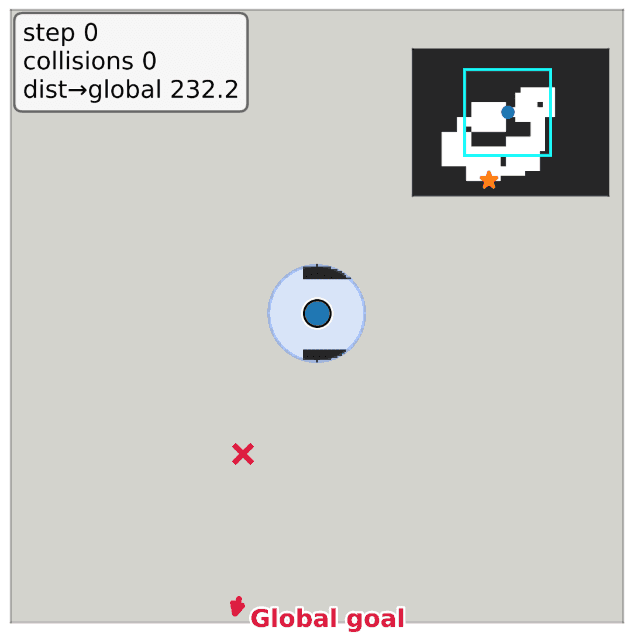
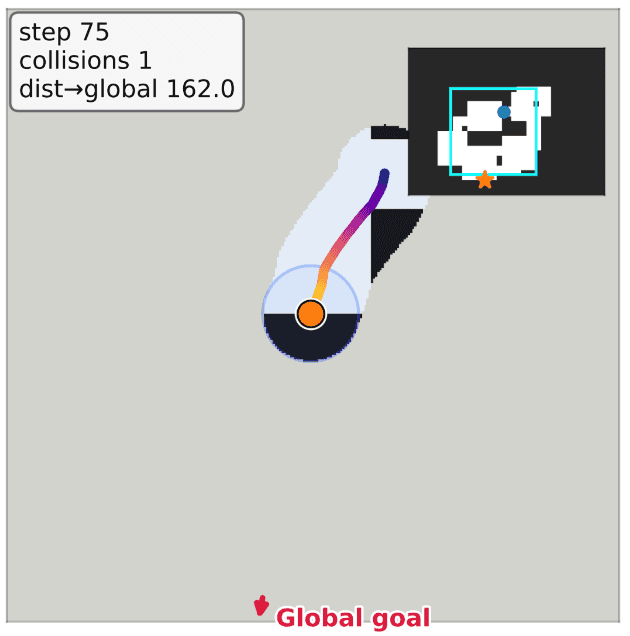
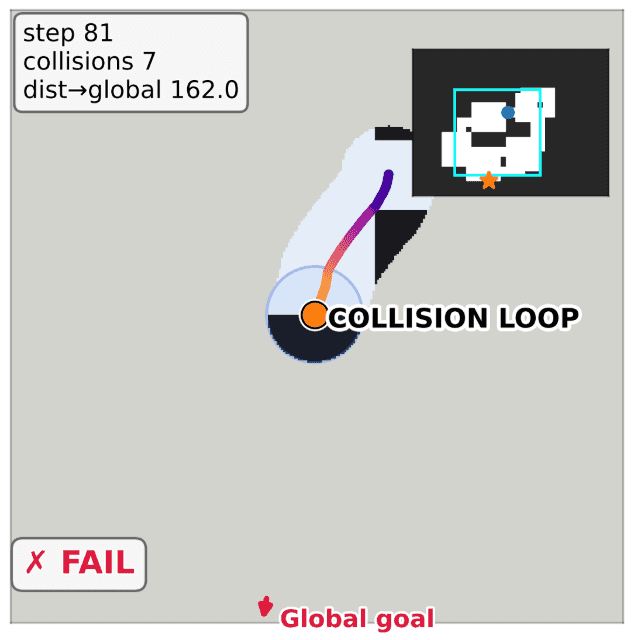
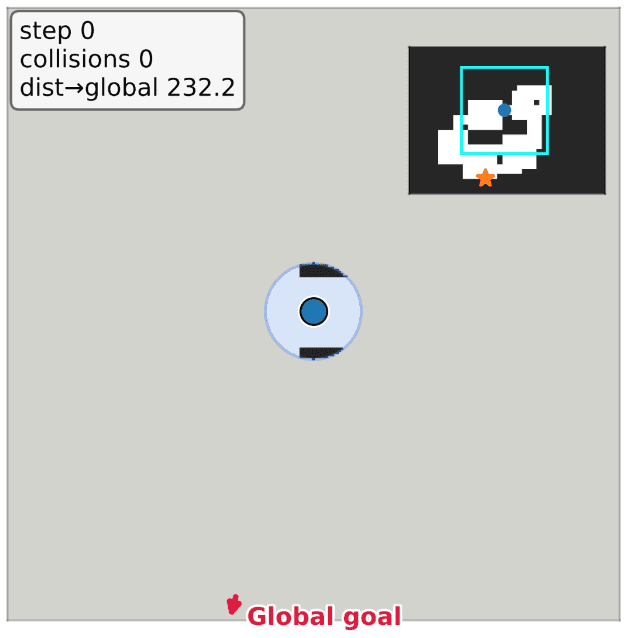
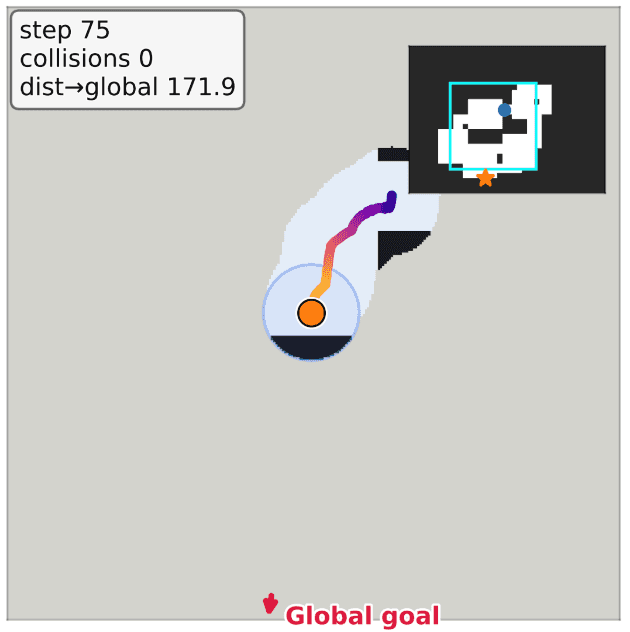
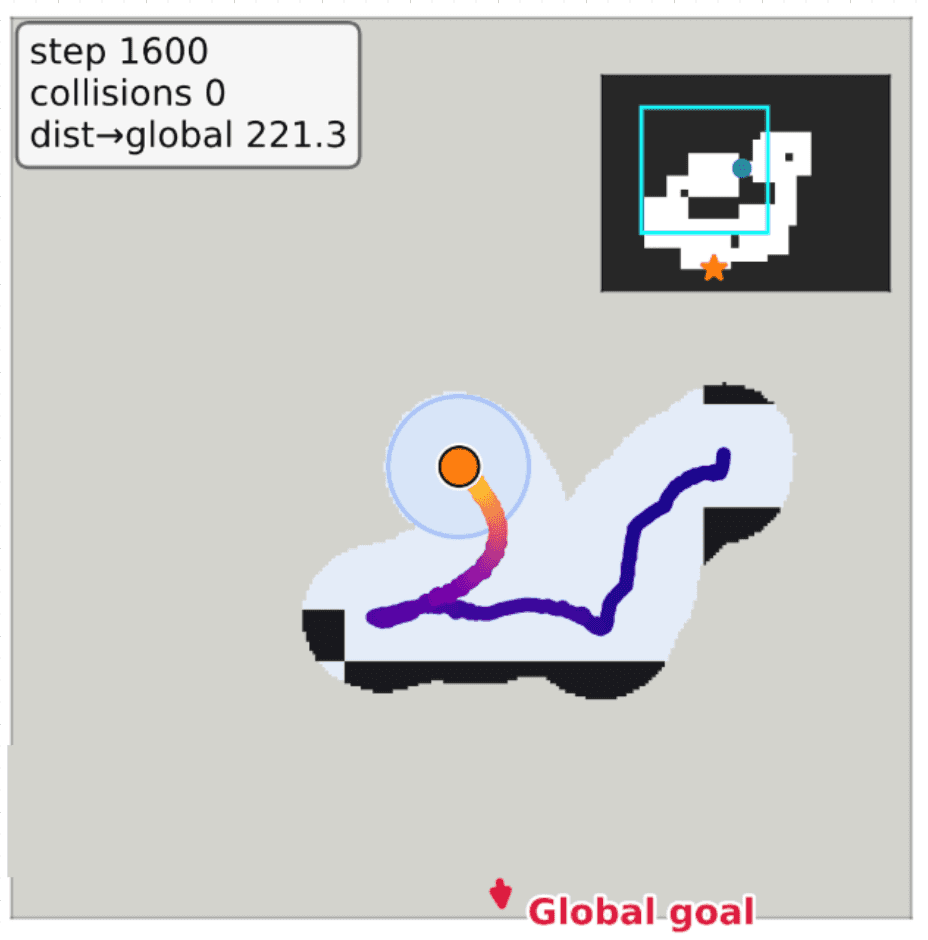
GRL-SNAM performs online Hamiltonian correction using only short-horizon feedback (clearance, goal distance, speed), adjusting its motion field to avoid obstacles and maintain progress.
| Baseline (Frozen RL) | |||
|---|---|---|---|
|
|
|
|
| Ours (GRL-SNAM) | |||
|
|
|
Figure 1 -- Fixed policy vs. online adaptation. Top row: a fixed RL controller enters a collision loop as local geometry changes. Bottom row: GRL-SNAM performs online correction by adjusting its Hamiltonian-shaped motion field using only short-horizon feedback, reaching the global goal.
Key Results at a Glance
| Metric | Value |
|---|---|
| Success Rate | 98.7% (nominal) |
| SPL | 0.95 |
| Workspace Mapped | ~10% |
| Training Steps | 500k (vs. 3--8M for RL) |
Core finding: Under identical sensing and interfaces, GRL-SNAM achieves CBF-level path efficiency while sensing only ~10% of the workspace. Deep RL baselines (PPO/TRPO/SAC) plateau below 30% success with 3--8M environment steps; GRL-SNAM reaches 87.5% success with 500k gradient steps on the dungeon benchmark.
Contributions
-
Navigation via Hamiltonian Dynamics. We cast SNAM as learning a scenario-to-Hamiltonian map. The constrained optimal control problem per stage is reduced via PMP + barrier relaxation to a mechanical Hamiltonian whose forward flow map is the policy -- no backward HJB solve needed.
-
Multi-Scale Energy Coordination. Three sub-modular policies (sensing, frame, shape) evolve at natural timescales under shared dual weights, achieving temporal scale separation without hand-designed hierarchies.
-
Offline--Online Adaptation. Offline: learn reference Hamiltonians from trajectory data. Online: adapt energy weights via secant Jacobian estimation on short-horizon observables -- stable, low-variance, structure-preserving.
-
Deformable Robot Validation. A hyperelastic ring robot that must squeeze through cluttered narrow passages -- a task where rigid planners provably fail. GRL-SNAM outperforms all baselines on success, safety, and efficiency.
Method
The Core Idea: Learn the Energy and the Dynamics, Not the Action
GRL-SNAM replaces reward-maximizing policies with a learnable Hamiltonian system -- both the energy landscape and the dynamics it induces. A small neural network (the "navigator" ) takes local environment context and outputs nonnegative energy weights that shape the potential, a dissipation coefficient that governs how quickly the system damps, and a port correction term that injects non-conservative forces when energy reshaping alone is insufficient. Together, these define a complete generalized Hamiltonian dynamics whose forward flow map directly generates the robot's trajectory.
The Reduced Hamiltonian:
The navigator maps environment context to dual weights that reweight these fixed energy terms plus a dissipation and port correction .
Modular Score-Field Architecture
Given the current state , goal , and locally sensed environment context, the navigator tokenizes active constraints and outputs meta-parameters: energy weights, frame dissipation, and an optional port input. These modulate a fixed library of interpretable energy terms to form module-specific Hamiltonians. A symplectic integrator rolls out the dynamics. Offline training learns the context-to-parameters mapping; online adaptation updates parameters using a smoothed secant Jacobian estimate.
Three Sub-Modular Policies
| Policy | Manifold | Timescale | Dynamics | Role |
|---|---|---|---|---|
| Sensor | Slow () | Purely symplectic | Acquire environment representation | |
| Frame | Medium () | Symplectic + dissipation + port | Local motion toward stage goals | |
| Shape | Fast () | Purely symplectic | Morphology control (e.g., squeezing) |
The policies are coupled through shared dual weights from a permutation-invariant set encoder and not a hand-designed hierarchy.
Online Adaptation: Secant-Based Energy Reshaping
During online navigation, GRL-SNAM tracks an observable vector:
Parameter corrections are computed via a smoothed secant Jacobian estimate and Tikhonov-regularized least squares. Any residual unresolvable by weight adjustment is handled by a port correction term .
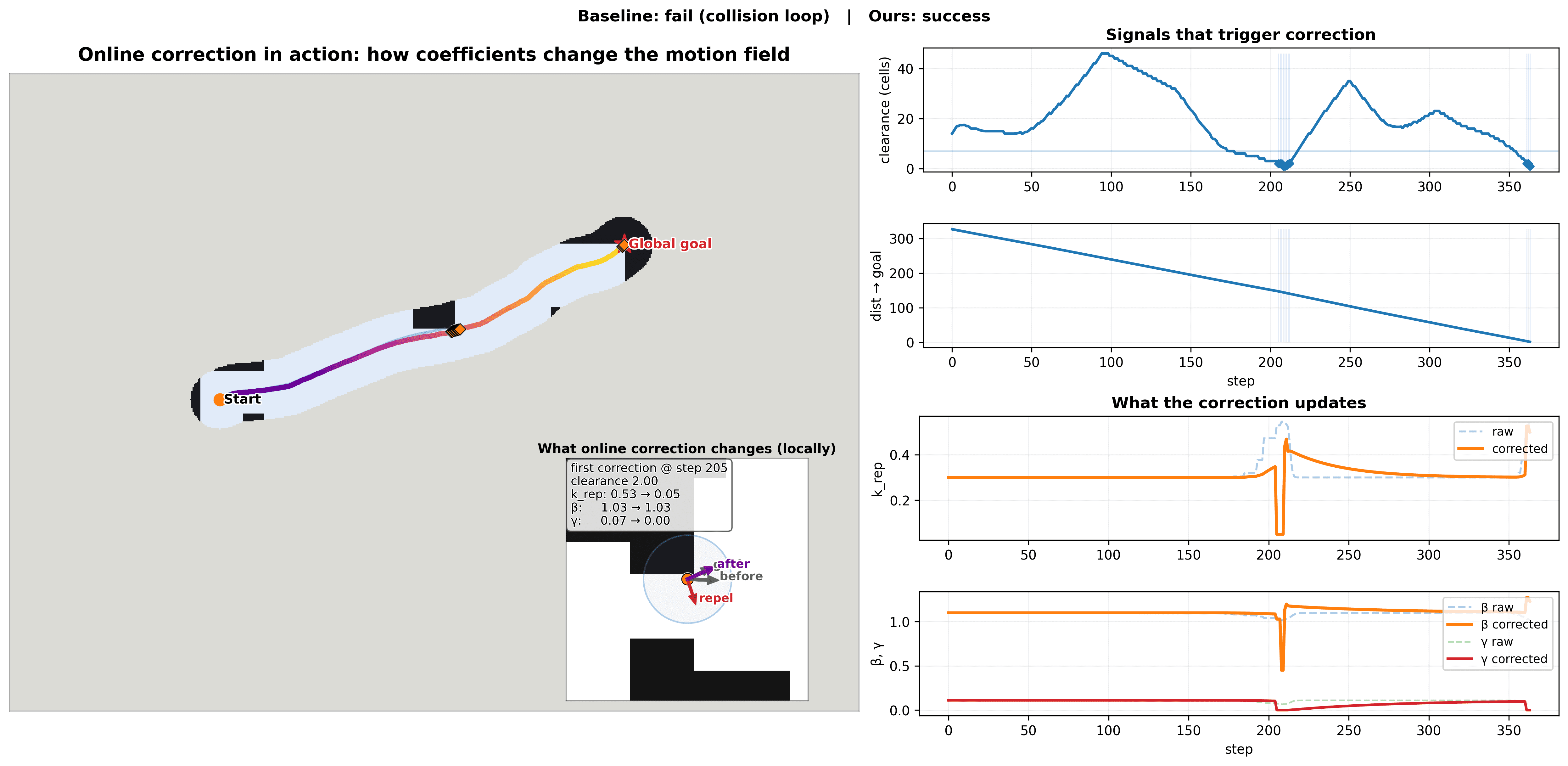
Figure 3 -- Online correction mechanism. Left: the frozen baseline enters a collision loop, while GRL-SNAM reaches the goal by applying local corrections. Right: the observable vector triggers adaptation; dual weights and dissipation are updated stage-locally to restore safety while maintaining goal progress.
Qualitative Results
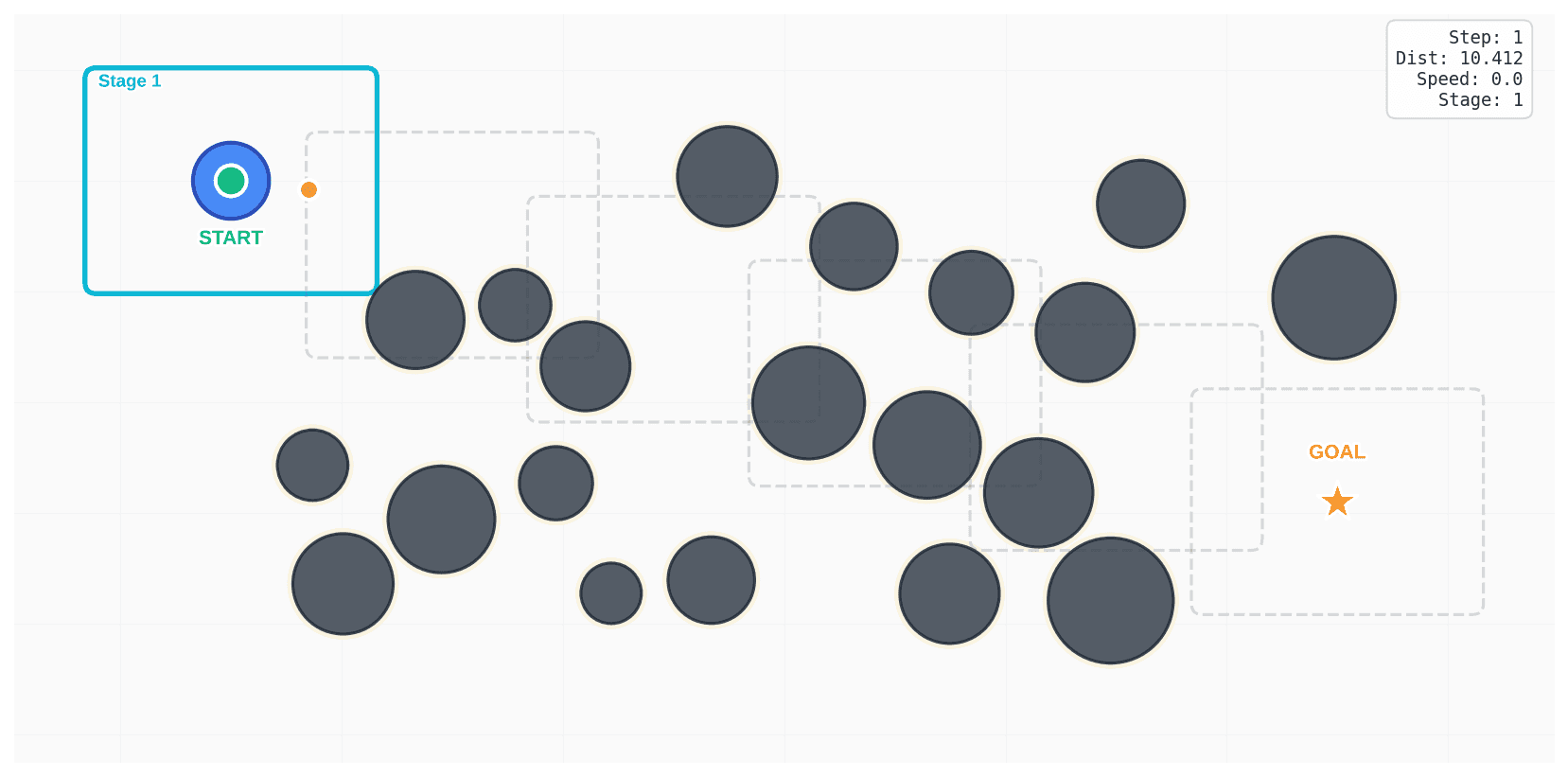
Episode Rollout Through Cluttered Layout
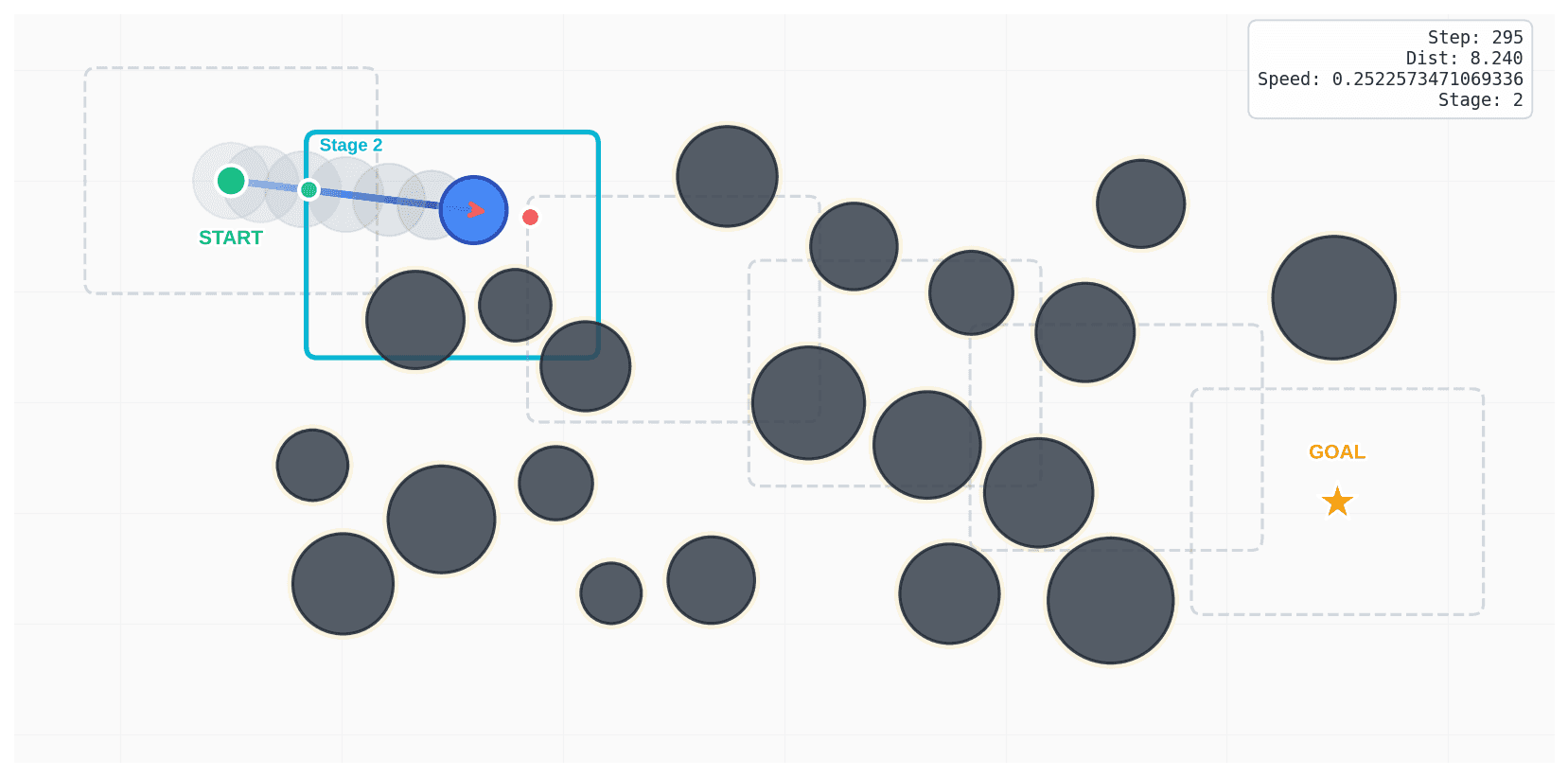
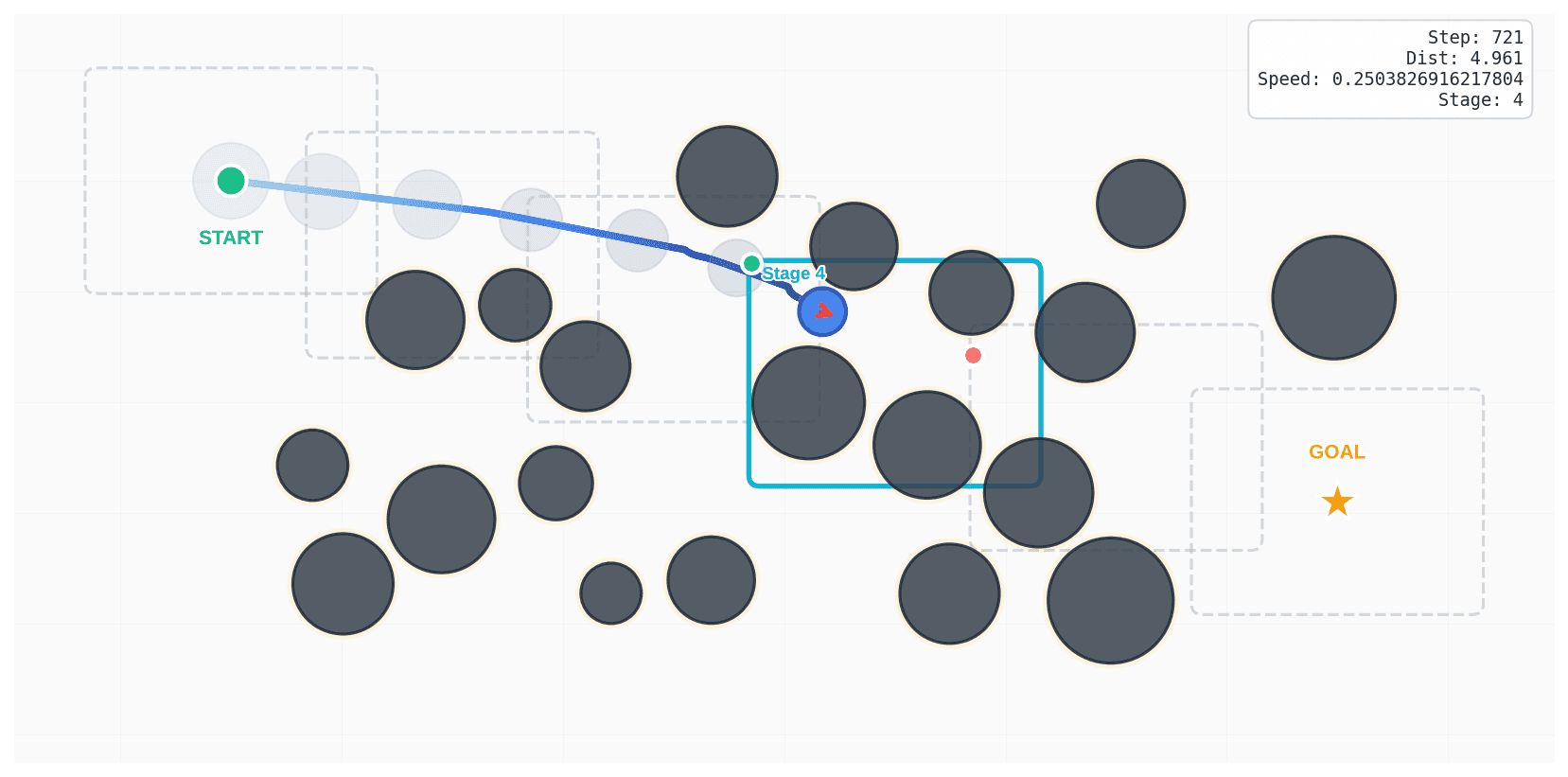
| t=1 | t=295 | t=721 |
|---|---|---|
|
|
|
| Initialization | Corridor commit | Squeeze-through |
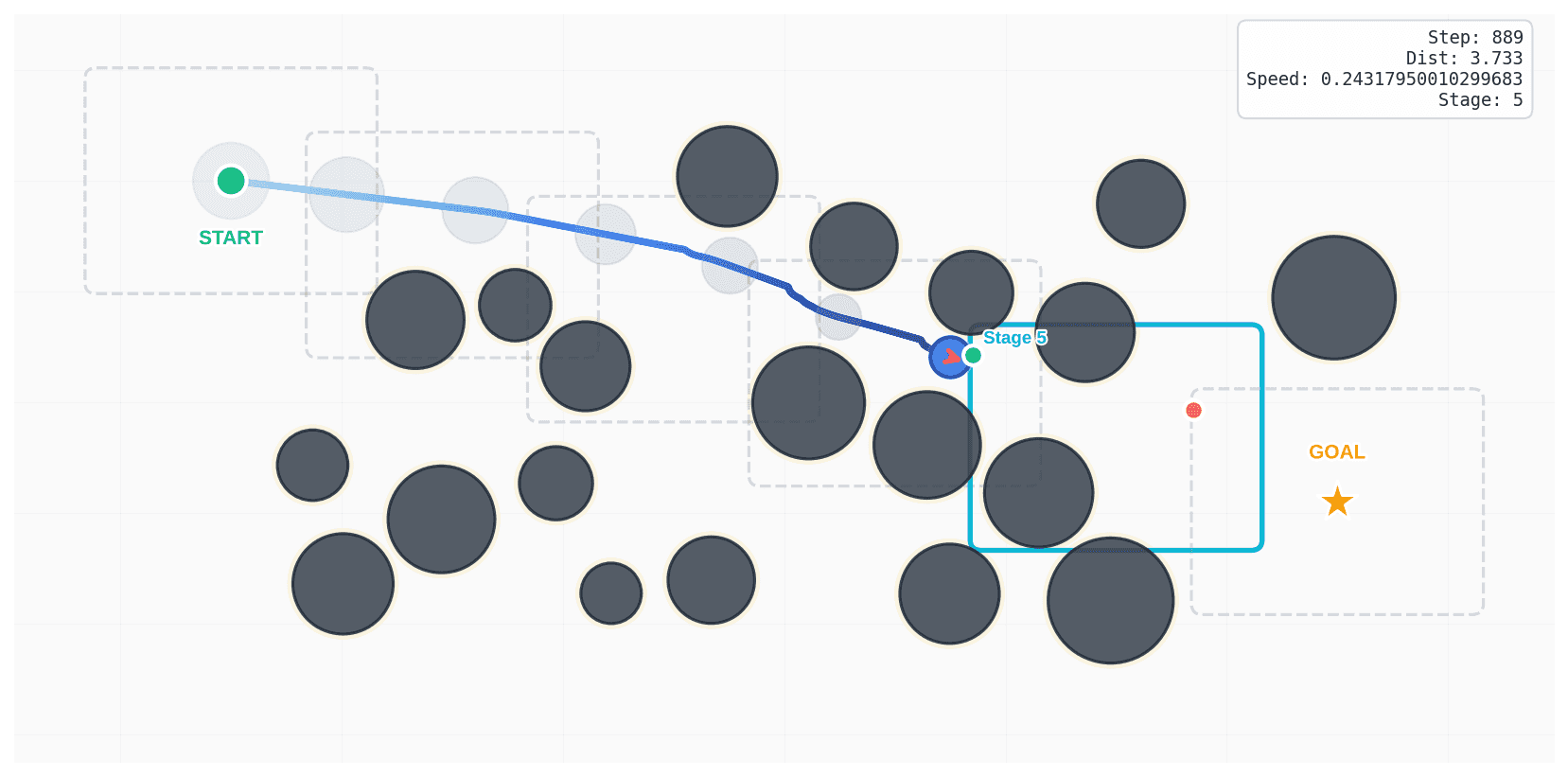
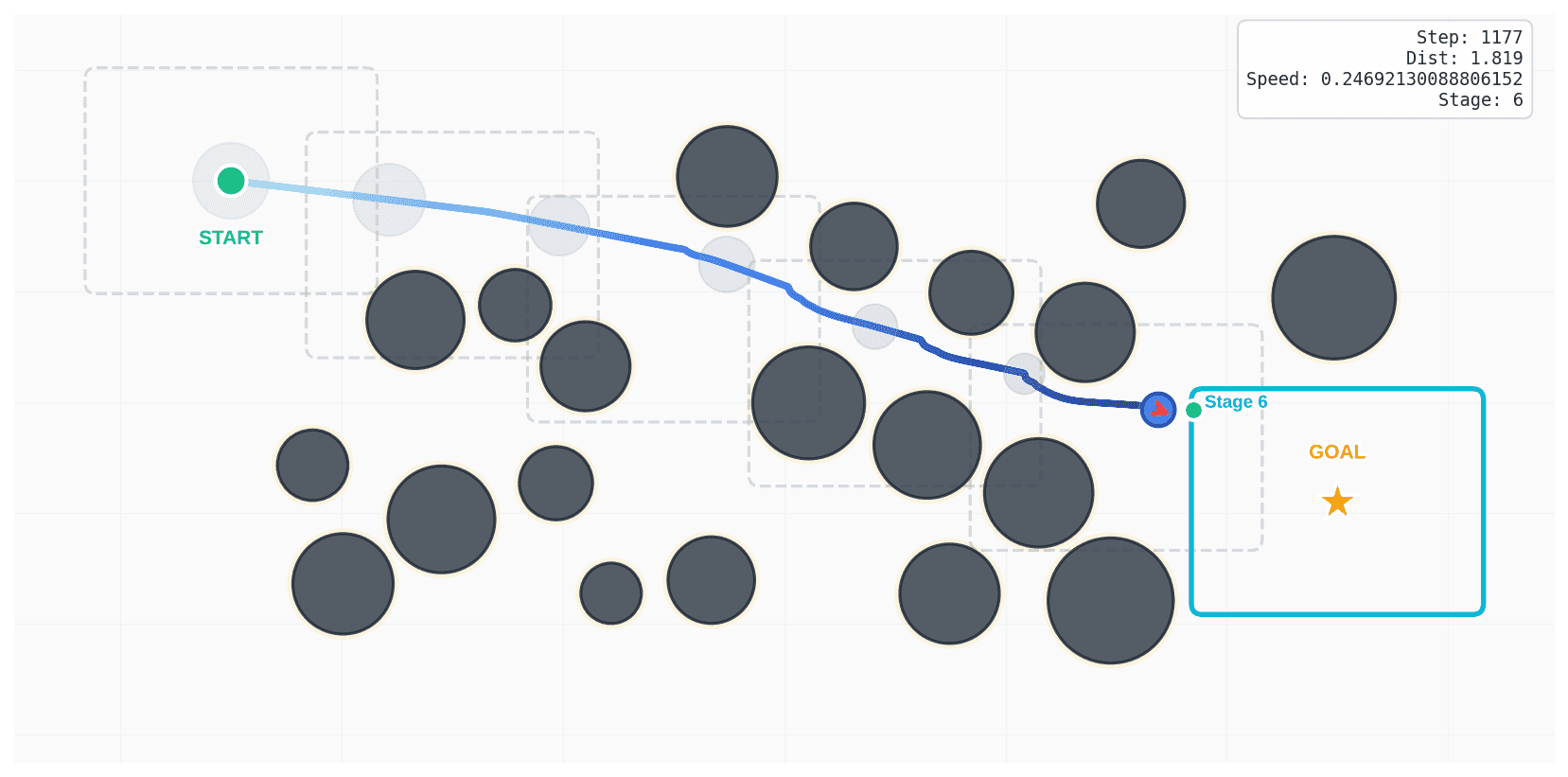
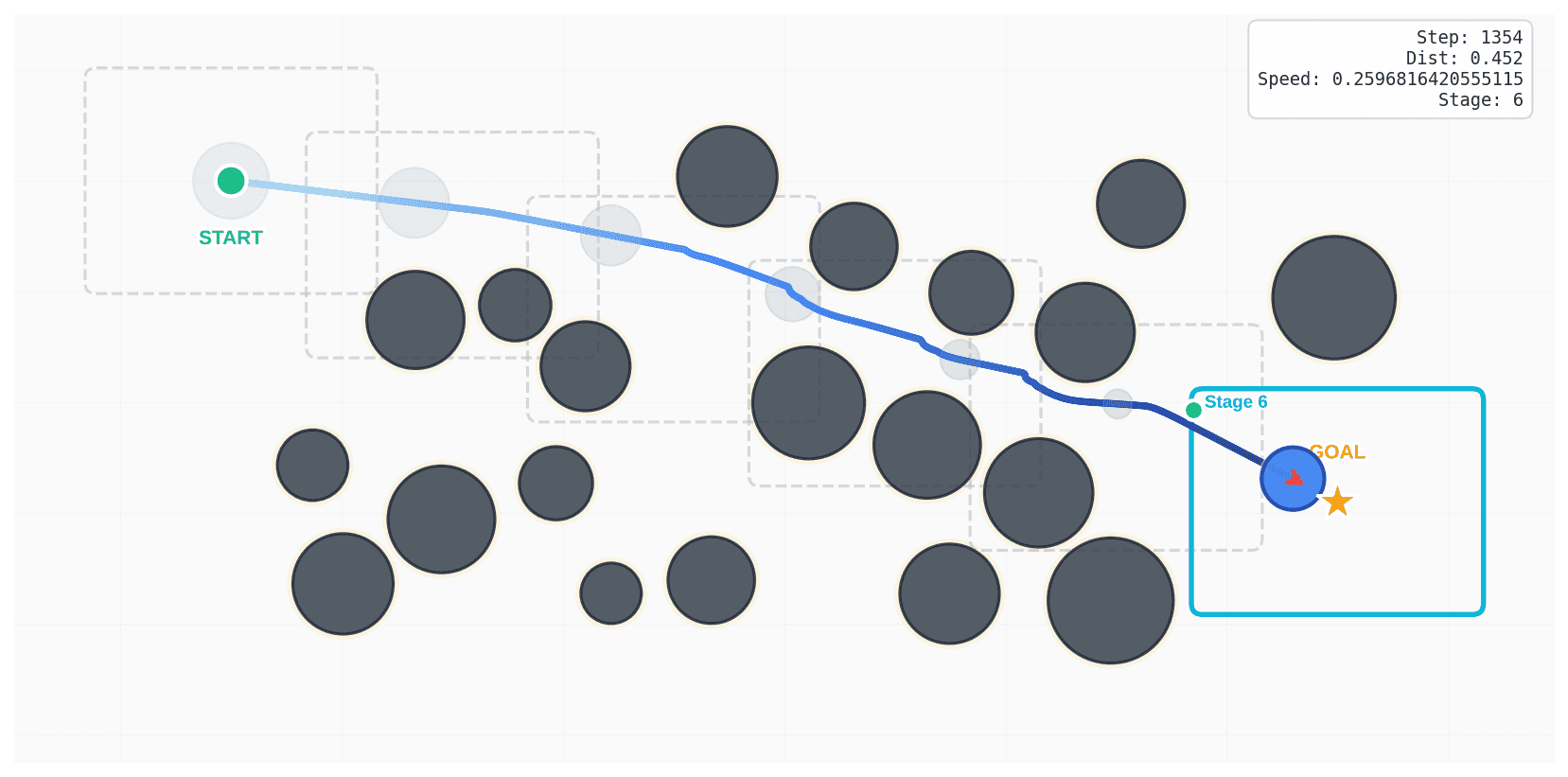
| t=889 | t=1177 | t=1354 |
|---|---|---|
|
|
|
| Recovery | Final approach | Goal reached |
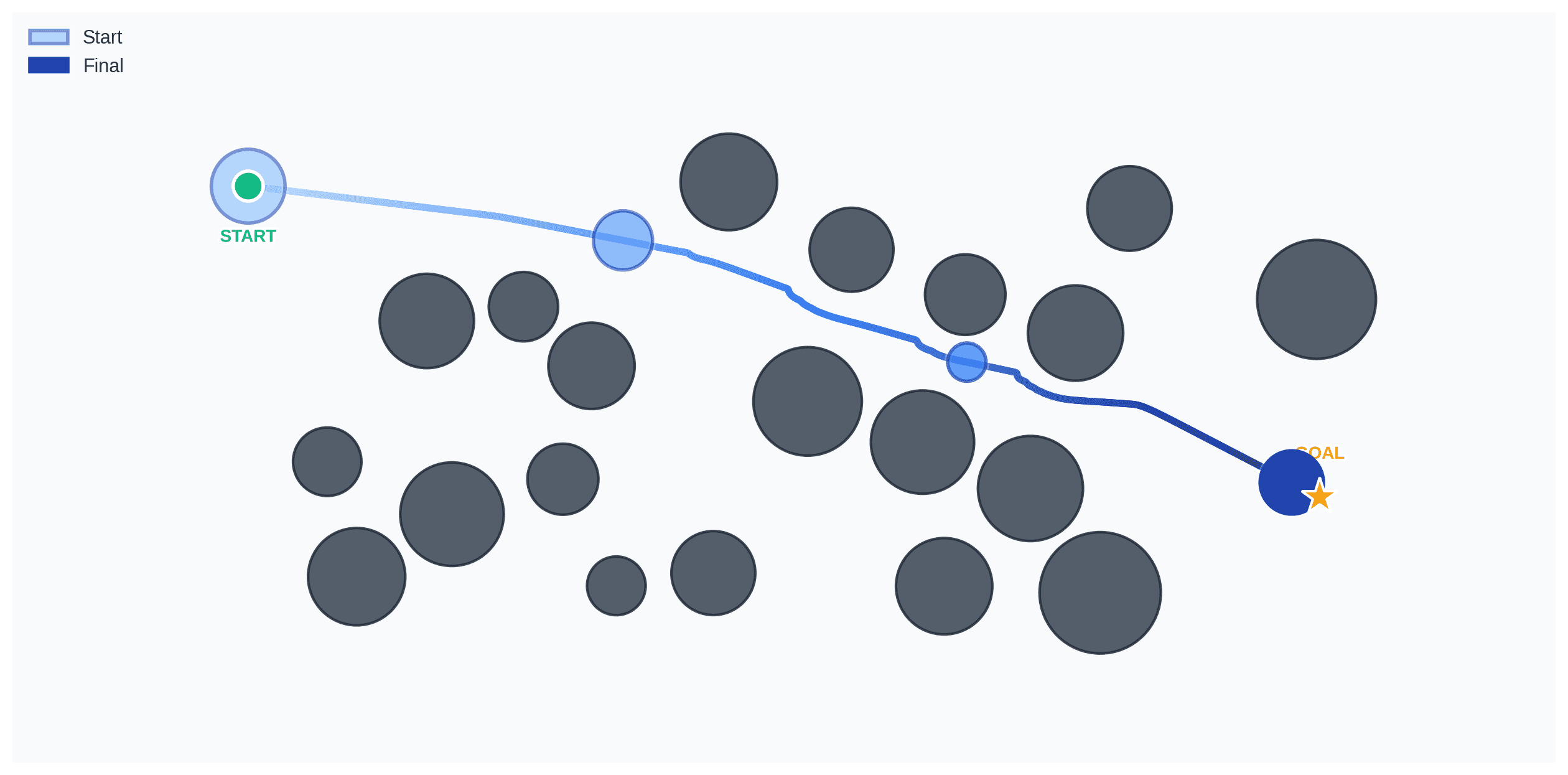
Figure 4 -- GRL-SNAM rollout on a cluttered layout. The agent progresses through initialization, corridor commitment, bottleneck entry, squeeze-through of a narrow passage, recovery/re-centering, and successful goal arrival. The full trajectory overlay shows a smooth, efficient path.
Dungeon Navigation Comparison
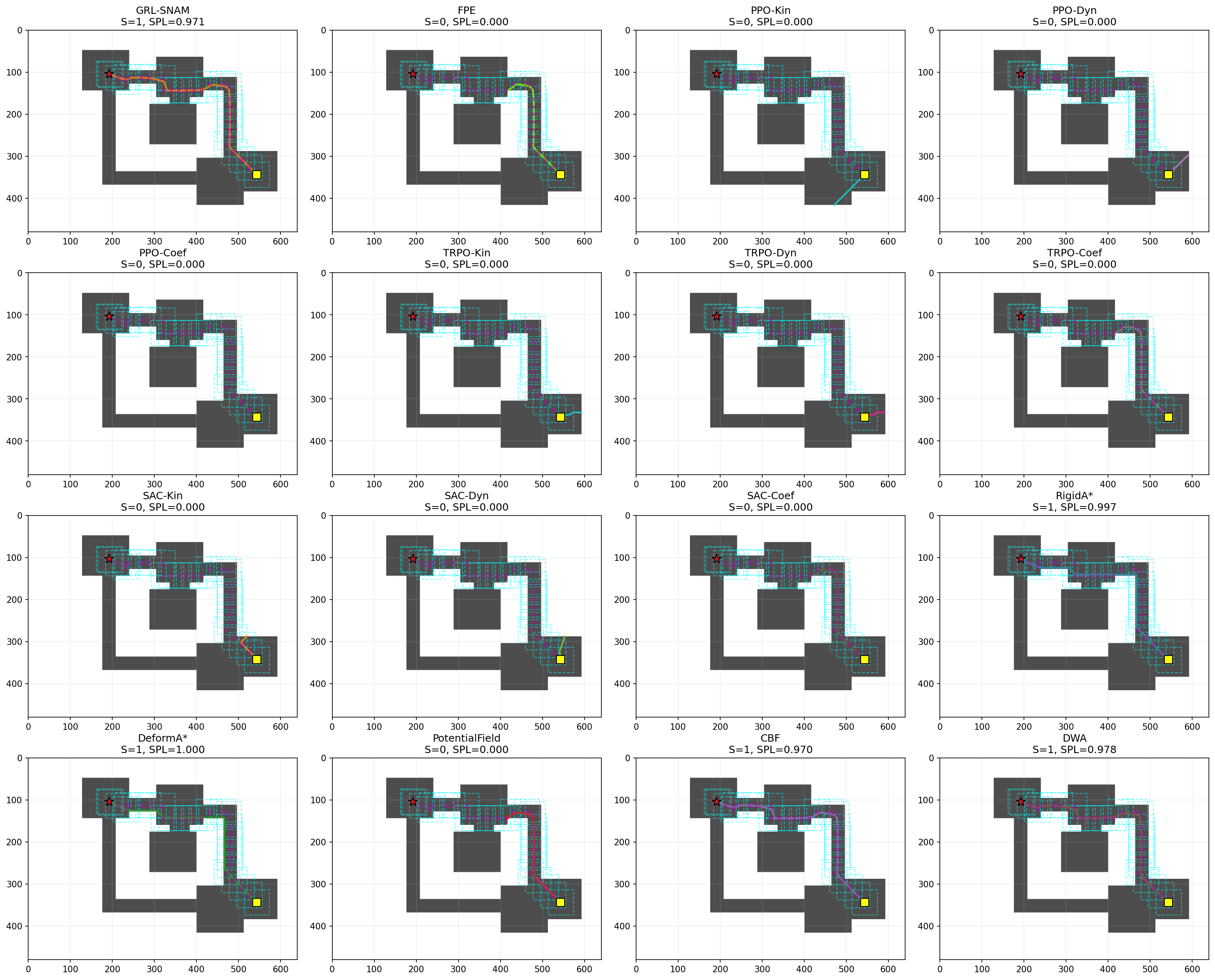
Figure 5 -- Representative dungeon rollouts under stagewise local sensing. Each panel shows the same layout with goal (red x), start (yellow square), executed trajectory (colored by time), and visited sensing windows (cyan). GRL-SNAM reaches the goal with near-planner efficiency; RL baselines and the greedy potential-field baseline fail.
Quantitative Results
Navigation Quality vs. Mapping Effort (Hyperelastic Ring)
All stagewise methods use the same sensing window and stage manager. RL variants share the same interface and short-rollout distribution -- only the learning rule differs.
| Method | SPL | Detour | Min Clear (m) | Mapping (%) |
|---|---|---|---|---|
| Potential Field | 0.77 | 1.42 | 0.18 | 10.3 |
| CBF | 0.96 | 1.04 | 0.32 | 11.2 |
| GRL-SNAM (Ours) | 0.95 | 1.09 | 0.26 | 10.7 |
| PPO-Kin | 0.14 | 1.87 | -0.36 | 15.4 |
| PPO-Dyn | 0.00 | 2.31 | 0.77 | 18.1 |
| TRPO-Coef | 0.57 | 1.44 | 0.004 | 15.3 |
| SAC-Coef | 0.57 | 1.53 | 0.004 | 14.6 |
Takeaway: GRL-SNAM matches CBF-level path efficiency (SPL 0.95 vs 0.96) at PF-level sensing cost (~10.7%), with strictly positive clearance. Deep RL consumes 14--18% mapping yet remains far behind.
Dungeon Navigation: Learning Strategy > Optimizer Choice
| Method | Success (%) | State Error (m) | Goal Dist (m) | Training Steps |
|---|---|---|---|---|
| PPO (full-episode) | 7.2 | -- | 14.1 | 5M env |
| TRPO (full-episode) | 3.8 | -- | 23.7 | 6.5M env |
| SAC (full-episode) | 1.5 | -- | 20.2 | 8M env |
| PPO (stagewise) | 26.1 | 1.8 | 1.2 | ~3.2M env |
| TRPO (stagewise) | 21.7 | 2.1 | 1.5 | ~3.8M env |
| SAC (stagewise) | 18.4 | 2.4 | 1.9 | ~4.1M env |
| GRL-SNAM (Ours) | 87.5 | 0.3 | 0.1 | 500k grad |
With dynamics, sensing, and encoder fixed, swapping PPO/TRPO/SAC changes results modestly but does not close the gap. The advantage is driven by Hamiltonian-structured supervision, not algorithm choice.
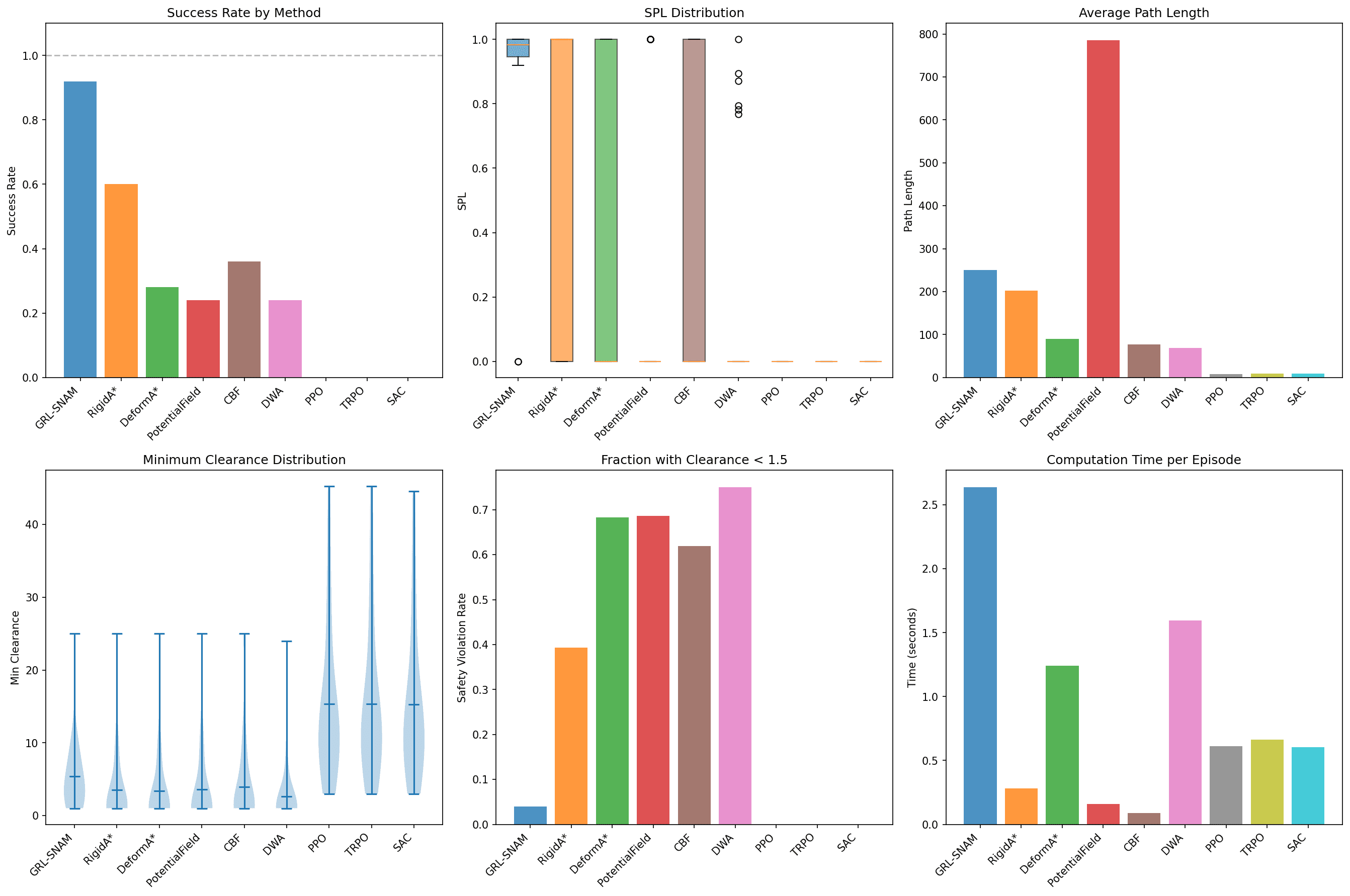
Aggregate Performance Dashboards
| Test-ID | Test-OOD |
|---|---|
|
|
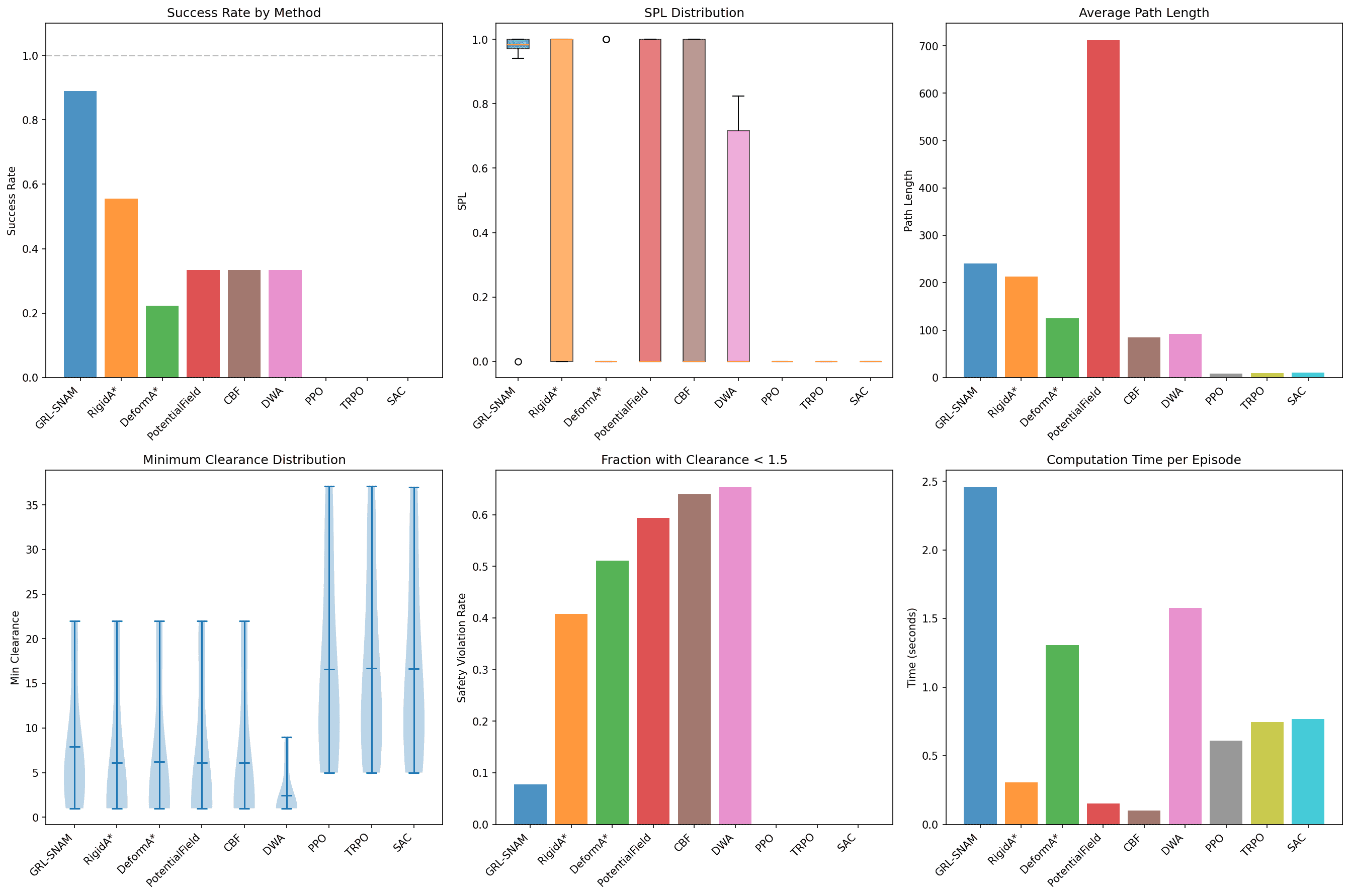
Figure 7 -- Test-ID / Test-OOD dashboards. Top row: success rate, SPL distribution, path length. Bottom row: min clearance distribution, grazing rate, compute time. GRL-SNAM achieves high success with SPL concentrated near 1.0 while maintaining strictly positive clearance at moderate compute.
Analysis: What Does GRL-SNAM Learn?
Temporal Coefficient Adaptation
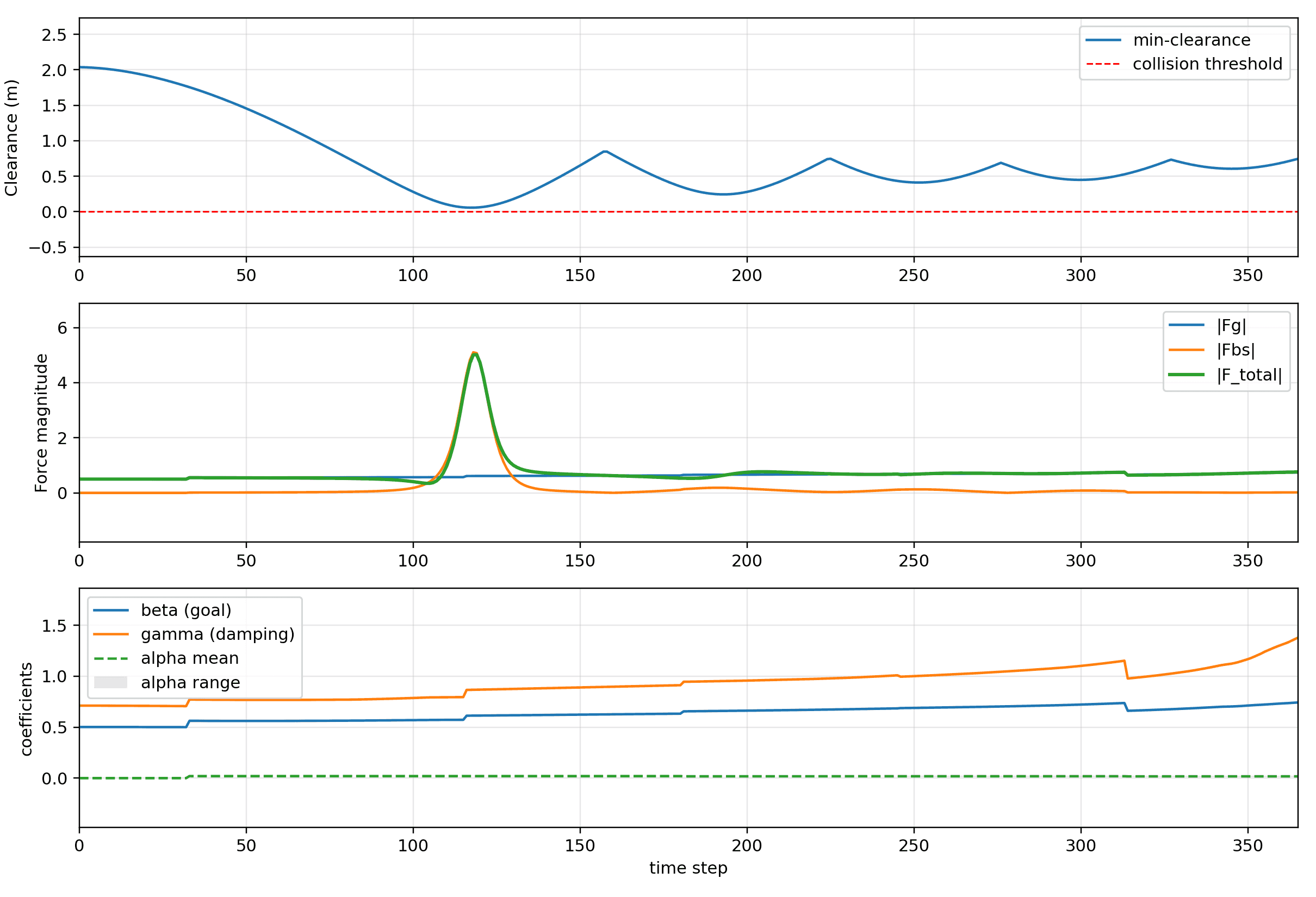
Figure 9 -- Temporal analysis of Hamiltonian adaptation. Top: minimum clearance drops near bottlenecks and recovers after passage. Middle: force magnitudes rebalance accordingly. Bottom: coefficients vary smoothly, confirming adaptation occurs through Hamiltonian parametrization, not ad hoc action scaling.
Learned Barrier Profiles Match Physics
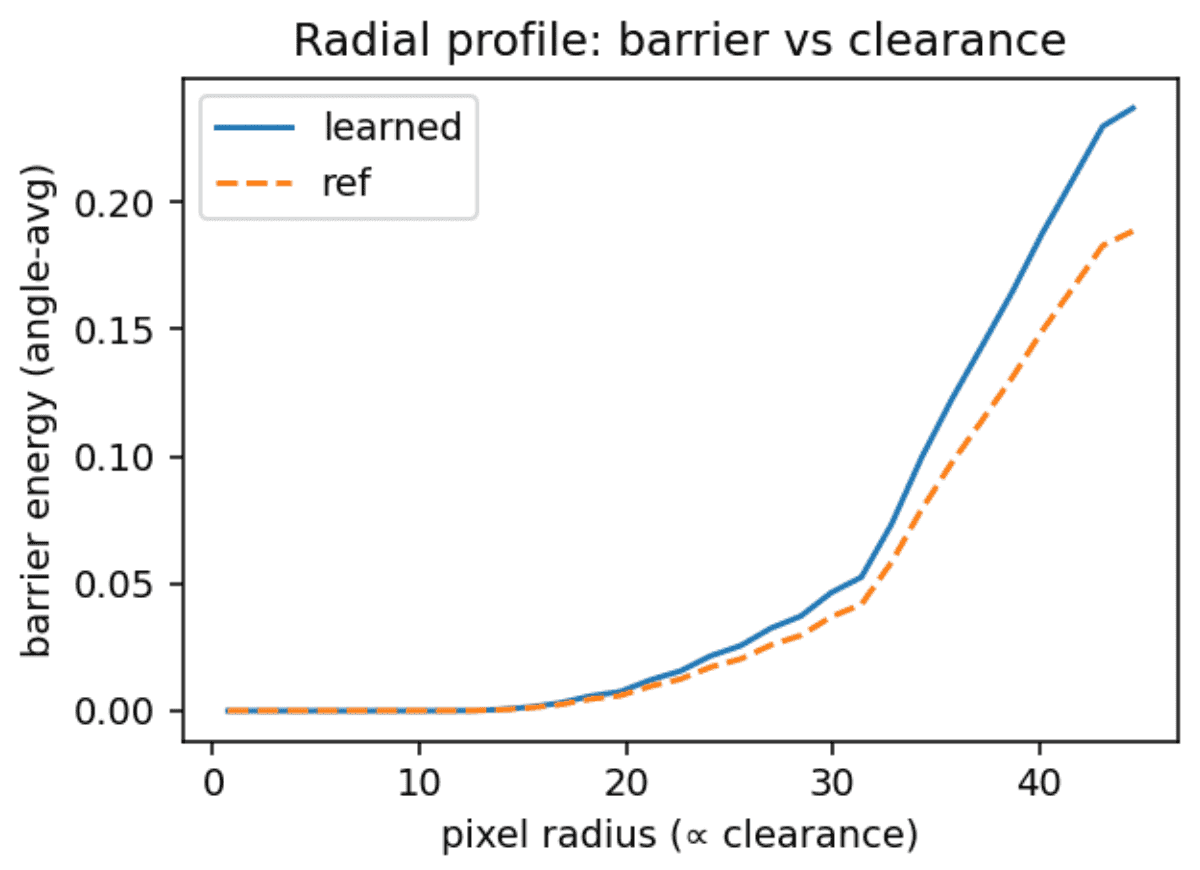
Figure 10 -- Radial barrier energy vs. clearance. The angle-averaged learned barrier (solid) closely tracks the analytic reference (dashed) -- near-zero at large clearance, sharp rise near contact -- while slightly softening at intermediate distances and steepening near contact, capturing additional deformation/friction costs.
Ablations
Effect of Loss Components
| Variant | Collisions | Min Clear | Progress/SPL | Behavior |
|---|---|---|---|---|
| No friction, no multi-start | High | < 0 | Poor | Penetrates obstacles |
| No friction, with multi-start | Low | High | Low | Very slow, conservative |
| With friction, no multi-start | None | High | High | Smooth, stable, fast |
| Both (full model) | None | Good | High | Stable; tighter margins |
Friction loss prevents oscillatory barrier violations; multi-start loss adds near-contact robustness. Combined gives the best overall trade-off.
Robustness to Sensing and Dynamics Perturbations
| Perturbation Level | Success (%) | SPL | Min Clear (m) | Collisions |
|---|---|---|---|---|
| Nominal (0.0, 1.0) | 98.7 | 0.82 | 0.36 | 0.3 |
| Mild Noise (0.05, 0.9) | 91.3 | 0.79 | 0.33 | 0.7 |
| Severe Noise (0.10, 0.7) | 87.1 | 0.72 | 0.29 | 1.1 |
Even under severe noise, GRL-SNAM maintains 87% success -- still outperforming RL baselines at nominal conditions. The energy landscape reshapes adaptively rather than overfitting to a single model.
The Hyperelastic Ring Robot
Our test platform is a planar hyperelastic ring with a periodic cubic B-spline boundary. It is the simplest soft body that provably requires shape change to solve our benchmarks -- a rigid disc of any fixed radius cannot pass through the same bottlenecks.
The shape policy controls a single deformation DOF (uniform scale s), with a clearance-dependent target:
This encourages compression in tight passages while keeping the ring expanded in free space.
How GRL-SNAM Differs from Standard RL
| Standard Deep RL | GRL-SNAM | |
|---|---|---|
| What is learned | Policy or value | Hamiltonian |
| Update mechanism | Bellman backups / policy gradient | Forward Hamiltonian flow |
| Safety | External CBF projection layer | Internal barrier potentials in energy |
| Adaptation | Fine-tune entire policy | Reweight energy terms online |
| Structure | Flat Euclidean, unstructured | Symplectic, physics-preserving |
| Interpretability | Black box | Decomposable force fields |
| Sample efficiency | 3--8M env steps | 500k gradient steps |
Energy Landscape Exploration
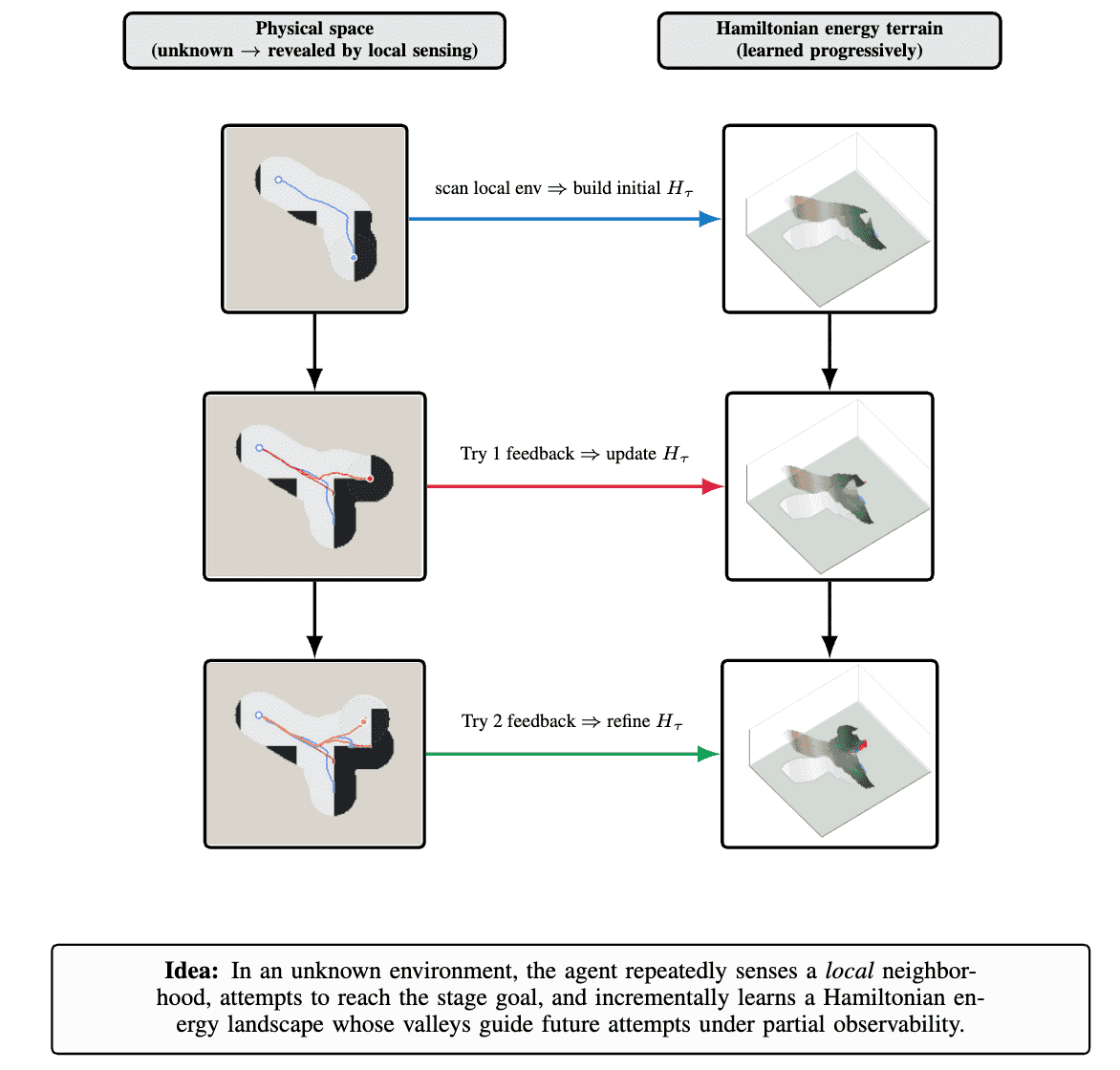
Figure 12 -- Energy landscape visualization. GRL-SNAM explores the geometry and topology of the Hamiltonian landscape. Each environment context maps to a shaped potential whose gradients induce goal-seeking, obstacle-avoiding, deformation-aware dynamics.
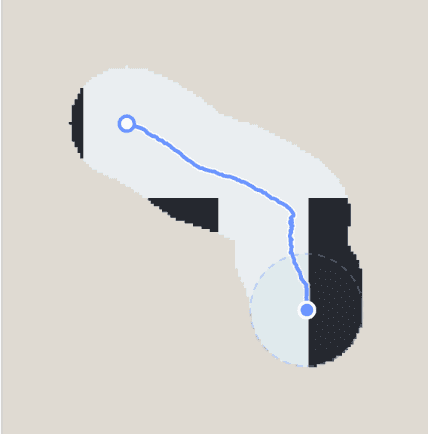
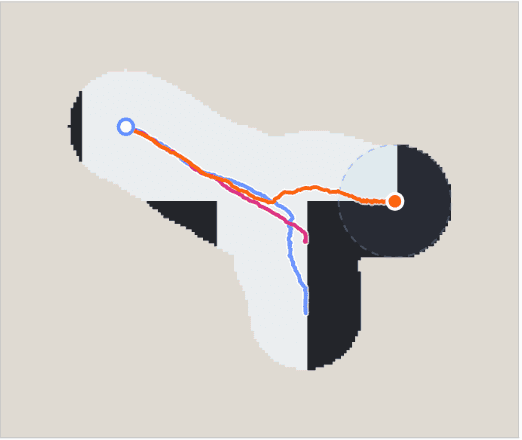
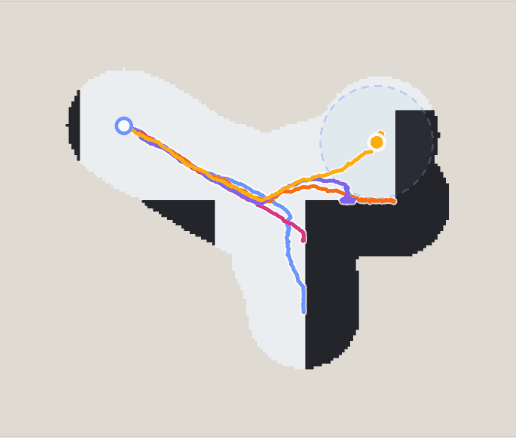
| Physical Trial 1 | Physical Trial 2 | Physical Trial 3 |
|---|---|---|
|
|
|
Citation
@inproceedings{ellendula2026grlsnam,
      title={GRL-SNAM: Geometric Reinforcement Learning with Path Differential
             Hamiltonians for Simultaneous Navigation and Mapping
             in Unknown Environments},
      author={Aditya Sai Ellendula and Yi Wang and Minh Nguyen
              and Chandrajit Bajaj},
      booktitle={International Conference on Learning Representations (ICLR)},
      year={2026},
      url={https://arxiv.org/abs/2601.00116},
}
Acknowledgements
This research was supported in part from the Peter O'Donnell Foundation, the Jim Holland-Backcountry Foundation and in part from a grant from the Army Research Office accomplished under Cooperative Agreement Number W911NF-19-2-0333.
People
- Chandrajit Bajaj (Principal Investigator)
- Aditya Sai Ellendula
- Yi Wang
- Minh Nguyen