

Aditya Sai Ellendula1, Yi Wang2, Chandrajit Bajaj1,2
1Department of Computer Science, The University of Texas at Austin
2Oden Institute, The University of Texas at Austin
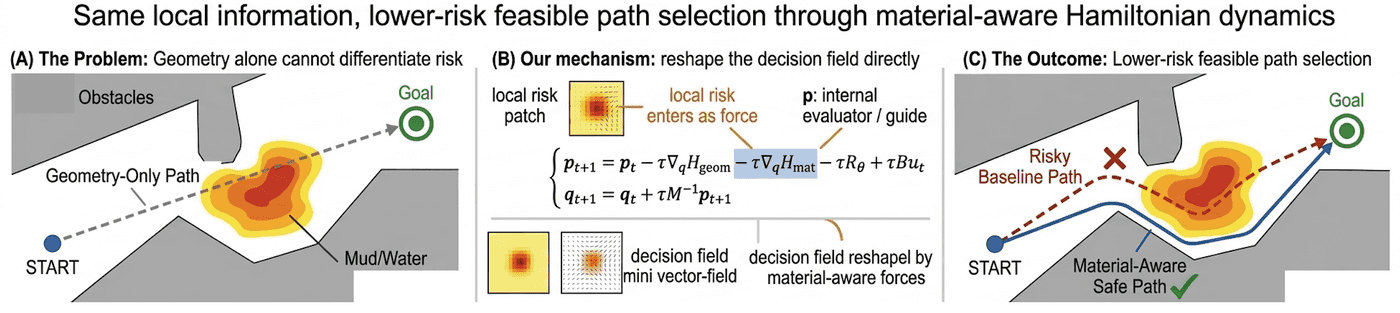
Selective reshaping of the decision field. (A) Geometrically feasible maneuvers can differ in material risk. (B) Adding the context-energy gradient to the cotangent update creates a context-force channel. (C) The channel bends toward a safer lane when one is feasible, but remains negligible when escape is boxed in.
TL;DR
Risk-aware navigation should be selective: a policy should expose evasive degrees of freedom only when the local scene admits a lower-risk feasible maneuver, and suppress them when no safer alternative exists. We show that adding one context-energy term to a port-Hamiltonian navigation policy produces a learned force channel with exactly this falsifiable signature.
The Selectivity Gap
When a lower-risk feasible maneuver exists, the robot should expose the evasive degree of freedom and take it; when the apparent escape is blocked, corrupted, or not yet open, it should suppress that same degree of freedom rather than hallucinate a detour. Classical planners, MPC/MPPI-style samplers, reactive controllers, and learned policies all address parts of this problem, but none make this activation/suppression asymmetry an explicit structural property: risk costs tend either to pull everywhere a gradient exists, causing false maneuvers, or to be damped enough that the system misses real escape opportunities.
The issue is acute in off-road terrain and local traffic. A patch that looks clear from geometry alone may be wet clay; a corridor that looks low-risk in the semantic map may be physically blocked; a lane change may be useful behind a slow leader but unsafe when the adjacent lane is boxed in. The agent must decide which force channels should be active under the current local context, and which should remain latent.
Method: One Additive Energy Term
The geometry-only policy and the context-enriched field share the same phase-space update. The only dynamical addition is the context-force term in the momentum equation:
New sensory information therefore enters through the cotangent variable , not through a separate critic or global replanner. The decision field is the policy: changing the stored energy changes the vector field that generates the next motion.
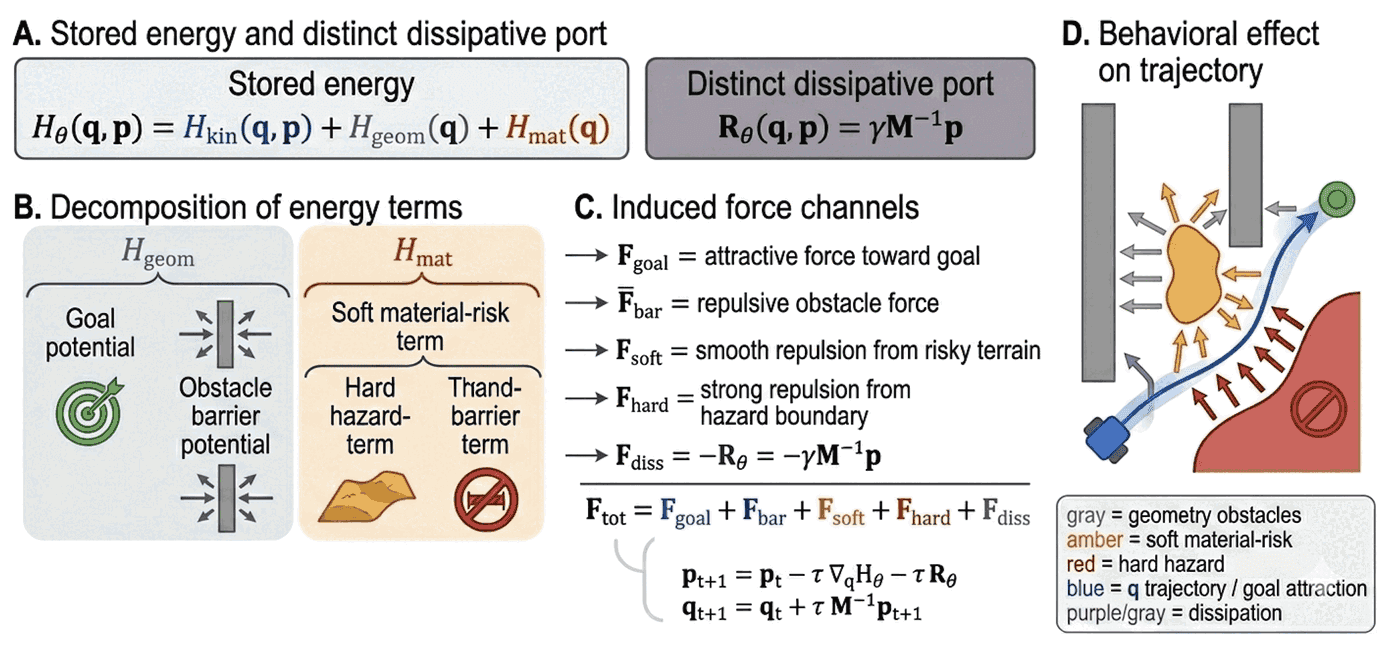
Factored stored energy and induced force channels. The stored energy separates kinetic, geometric, dissipative, and context terms. The context term creates a soft-risk deflection channel and a hard-hazard repulsion channel. The route-aware gate lets the soft channel shift the field only when a feasible lower-risk maneuver exists; otherwise the rollout stays near the geometry-only policy.
Differentiating yields two force channels: , a lateral risk deflection expressing preferences among feasible maneuvers, and , a differentiable penalty against boundary contact. Risk is therefore not a post-hoc cost, but a force that reshapes the local closed-loop dynamics.
Route-aware gate. The scalar soft-risk force can overreact when a low-risk-looking region is blocked by a fence, berm, or vehicle. We gate only the soft-risk channel with a local affordance test over short-horizon primitives sampled inside the current BEV patch. The soft channel opens only if the best feasible primitive improves soft risk by margin , clears the SDF, and is locally traversable. If any test fails, is suppressed while remains active. The test is local and differentiable, and does not call a global planner.
Tail-risk objective. Because the relevant failures are rare, expected-cost training can be dominated by typical rollouts. We optimize the empirical Rockafellar–Uryasev CVaR objective with and , so gradient flows through the worst rollouts and acts exactly on those where the context force can change the outcome.
Selectivity Is Structural, Not Tuned
Proposition 1 formalizes the coupling: enrichment is not merely a new cost term, but a coordinated enlargement of the force field, learning pathway, and update timescale. Over any finite horizon:
- C1 — Geometry-only preservation. If the context force stays below , the context-enriched rollout remains within of the geometry-only rollout.
- C2 — No hallucinated escape. If the lateral component stays below , lateral deviation from the geometry-only rollout is bounded by .
- C3 — Selective risk deflection. Given a feasible lateral direction with projected risk-gradient margin , one semi-implicit step decreases local soft risk by whenever .
C1–C3 follow from the gradient structure of and the affordance gate, not from post-hoc tuning.
Results
Primary head-to-head: delayed required escape. The lateral maneuver is blocked early, necessary later, and must be timed without global replanning. All methods receive the same updated BEV patch at every step; only the decision mechanism differs.
| Method | False pre-act ↓ | Suppress ↑ | Success ↑ | Viol. CVaR ↓ |
|---|---|---|---|---|
| Geometry-only policy | 0.000 | 1.000 | 0.030 | 1.894 |
| Risk-loss-only | 0.420 | 0.580 | 0.040 | 1.793 |
| Fixed-coeff context field | 0.990 | 0.010 | 0.030 | 0.463 |
| Black-box CVaR policy | 0.920 | 0.080 | 0.200 | 0.503 |
| DWA semantic | 0.950 | 0.050 | 0.480 | 0.695 |
| MPPI semantic | 0.950 | 0.050 | 0.240 | 0.831 |
| Ctx-enriched, expected | 0.370 | 0.630 | 0.620 | 0.855 |
| Route-aware Ctx CVaR | 0.180 | 0.820 | 0.810 | 0.740 |
Route-aware CVaR reduces DWA and semantic MPPI false pre-activation from 0.950 to 0.180 while raising success from 0.480/0.240 to 0.810, with zero replans.
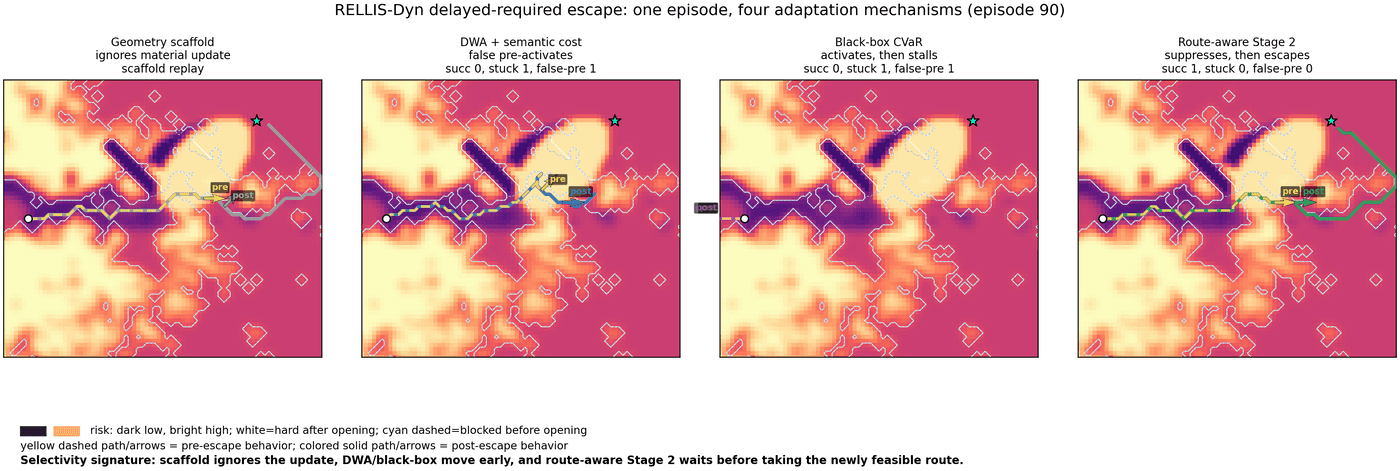
Qualitative temporal selectivity in one delayed-required escape episode. Yellow dashed trajectories show behavior before the escape is available; solid colored trajectories show behavior after it opens. The geometry-only policy ignores the material update, DWA and black-box CVaR move before the escape is feasible and then stall, while route-aware context enrichment suppresses before the escape opens and takes the newly feasible route once it does.
RELLIS-3D spatial selectivity (2,250 BEV episodes, leave-one-sequence-out). Route-aware enrichment achieves correct activation rate 0.837 and false activation rate 0.114, versus 0.378/0.752 for scalar risk gradients, with the best selectivity ratio (2.358) and AUPRC (0.289).
DFC2018 static semantic maps (300 paired episodes). Enrichment repairs a geometry-only policy: success 0.867 → 1.000, catastrophic failure 0.600 → 0.100, hard-hazard traversal −96.9%, cumulative risk −59.2%, oscillation −90.7%, path-length ratio unchanged.
Highway-env interaction selectivity. Removing the lateral channel causes collision with the slow leader on every episode; adding it without the TTC channel causes off-road failure in the boxed scenario. Only the full system passes when an escape is feasible and suppresses when it is not.
What the ablations isolate. Black-box CVaR uses the same objective and the same BEV patch but no Hamiltonian force channel: false pre-activation 0.920 and success 0.200 versus 0.810. Static CAR 0.884 does not transfer to temporal suppression. Without adaptive coefficients, the method suppresses nothing (success 0.030 vs. 0.810).
Abstract
Risk-aware navigation should be selective: a policy should expose evasive degrees of freedom only when the local scene admits a lower-risk feasible maneuver, and suppress them when no safer alternative exists. We show that adding one context-energy term to a port-Hamiltonian navigation policy produces a learned force channel with exactly this falsifiable signature. When the local risk field contains a feasible lower-risk direction, the induced context force activates toward it; when the apparent escape is blocked or not yet available, a route-aware gate suppresses lateral force rather than hallucinating an unsafe maneuver.
A CVaR tail-risk objective focuses gradient updates on rare but consequential risk transitions. We validate the selectivity signature across four settings. In the primary delayed-required-escape benchmark, route-aware CVaR reduces premature force activation from 0.950 to 0.180 versus DWA while raising success from 0.480 to 0.810 with zero replans. On real off-road terrain (RELLIS-3D), route-aware enrichment achieves correct activation rate 0.837 and false activation rate 0.114, compared to 0.378/0.752 for scalar risk gradients. On static semantic maps (DFC2018), enrichment reduces catastrophic failure from 0.60 to 0.10 and oscillation by 90.7% while preserving path efficiency. In highway traffic, collisions drop from 100% to 0% when a lane escape is feasible; when no escape exists, the policy suppresses the lateral maneuver. The selectivity property follows from the gradient structure of the context energy rather than from training-time tuning.
BibTeX
@article{ellendula2026material,
  title   = {Learning Material-Aware Hamiltonian Risk Fields for Safe Navigation},
  author  = {Ellendula, Aditya Sai and Wang, Yi and Bajaj, Chandrajit},
  journal = {arXiv preprint arXiv:2605.07038},
  year    = {2026},
  url     = {https://arxiv.org/abs/2605.07038}
}
People
- Aditya Sai Ellendula
- Yi Wang
- Chandrajit Bajaj