

Shubham Bhardwaj1,2, Chandrajit Bajaj1
1Department of Computer Science & Oden Institute, The University of Texas at Austin 2Mihawk.ai
Paper | arXiv | Project Page
100-step open-loop rollouts across 8 physical systems. Blue = PHAST (Known), Green = PHAST (Partial), Red = GRU, Gold = S5, Purple = LinOSS, White = ground truth. PHAST tracks ground truth where baselines diverge.
TL;DR
We embed the port-Hamiltonian energy structure into a neural architecture that decomposes dynamics into potential , mass , and damping . Across 13 benchmarks spanning 6 physical domains, this structure alone yields the best long-horizon stability — outperforming S5, GRU, Transformers, and other baselines by up to .
Abstract
Real physical systems are dissipative — a pendulum slows, a circuit loses charge to heat — and forecasting their dynamics from partial observations is a central challenge in scientific machine learning. We address the position-only (-only) problem: given only generalized positions at discrete times (momenta latent), learn a structured model that (a) produces stable long-horizon forecasts and (b) recovers physically meaningful parameters when sufficient structure is provided.
The port-Hamiltonian framework makes the conservative-dissipative split explicit via , guaranteeing when . We introduce PHAST (Port-Hamiltonian Architecture for Structured Temporal dynamics), which decomposes the Hamiltonian into potential , mass , and damping across three knowledge regimes (KNOWN, PARTIAL, UNKNOWN), uses efficient low-rank PSD/SPD parameterizations, and advances dynamics with Strang splitting.
Across thirteen -only benchmarks spanning mechanical, electrical, molecular, thermal, gravitational, and ecological systems, PHAST achieves the best long-horizon forecasting among competitive baselines and enables physically meaningful parameter recovery when the regime provides sufficient anchors. We show that identification is fundamentally ill-posed without such anchors (gauge freedom), motivating a two-axis evaluation that separates forecasting stability from identifiability.
Three Knowledge Regimes, One Template
PHAST unifies three levels of prior knowledge under a single port-Hamiltonian template. The architecture is identical across regimes — only the component instantiations change.
KNOWN — : given from physics | : given from physics | : learned (PSD) | Identifiable E.g., pendulum, RLC circuit, Lennard-Jones, heat exchange
PARTIAL — : template + learned | : given | : learned (bounded) | Partially identifiable E.g., double pendulum, N-body gravity, cart-pole
UNKNOWN — : neural network | : neural SPD net | : neural PSD net | Not identifiable E.g., predator-prey, black-box dynamics
Shared across all regimes: port-Hamiltonian state with conservative-dissipative split | passivity guarantee by construction | Strang-split symplectic integration | causal velocity observer for -only input
Key Insight: Forecasting ≠ Identifiability
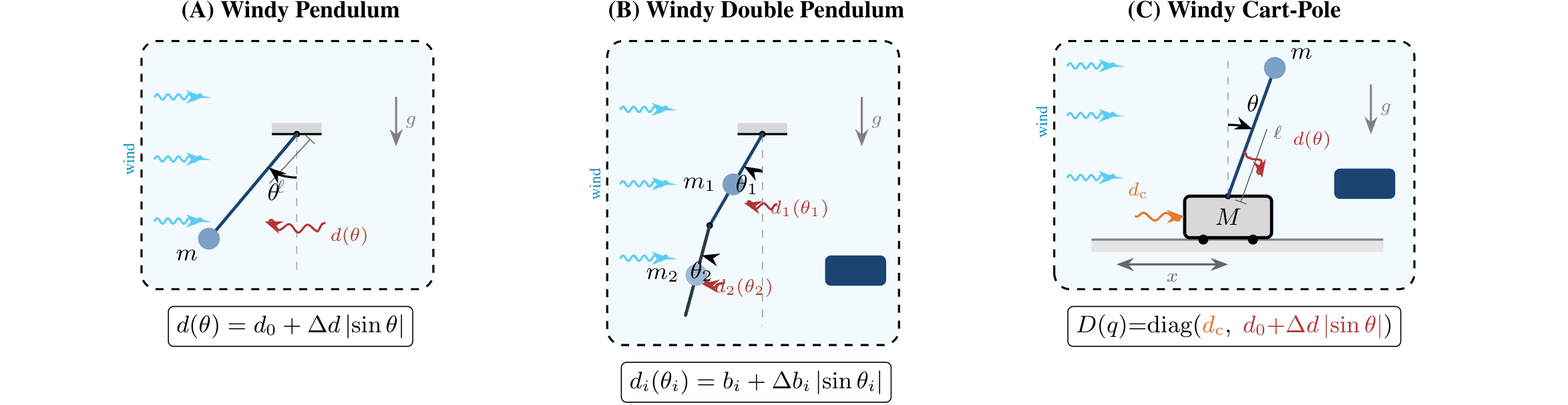
These three systems form a progression of structural complexity: Windy Pendulum (1-DOF, scalar damping ), Double Pendulum (2-DOF chain with configuration-dependent mass ), and Cart-Pole (mixed topology , per-DOF damping with two distinct mechanisms: constant cart friction and position-dependent angular wind damping ).
A model that forecasts well need not recover the true physics — damping can act as a "stabilizer" absorbing errors in or , making the inverse problem non-identifiable without sufficient structure. PHAST exposes this via two evaluation axes:
- Forecasting — rollout MSE at : PHAST (PARTIAL) achieves the best forecasting across all three systems
- Identifiability — damping vs. ground truth: PHAST (KNOWN) achieves near-perfect recovery () on Pendulum and Double Pendulum
Baselines (S5, LinOSS, VPT) do not expose explicit damping fields — they can forecast, but cannot tell you why the system dissipates.
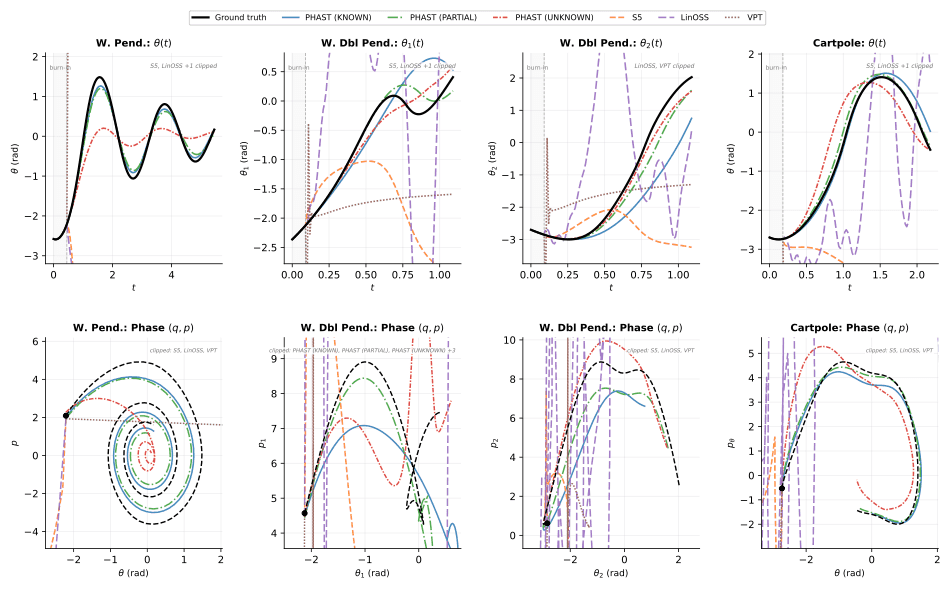 Rollouts & phase portraits: PHAST tracks ground truth in state and phase space.
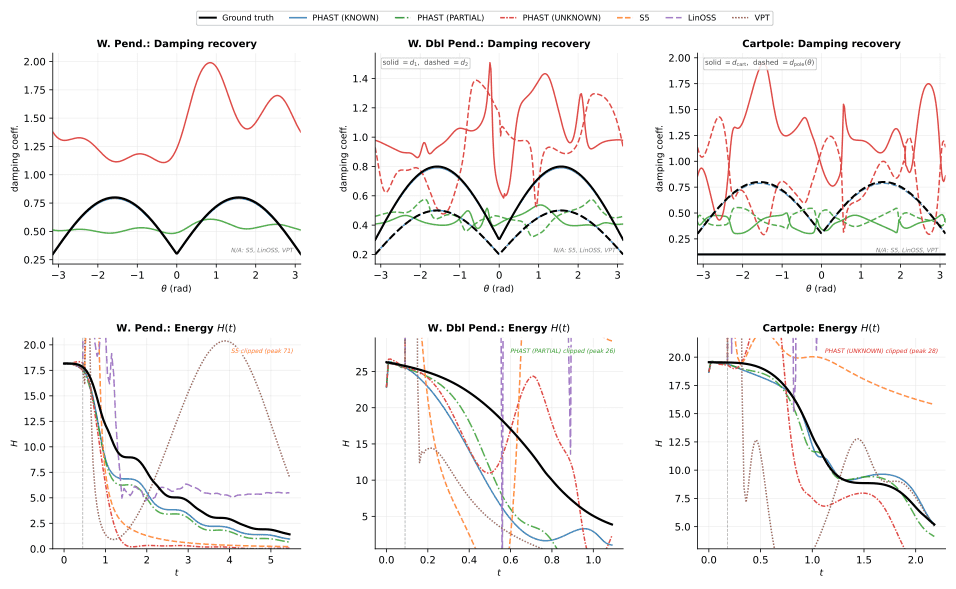 Damping recovery & energy passivity: KNOWN regime recovers true .
Benchmark Systems
Evaluated across 13 benchmarks spanning 6 physical domains. The 8 systems below appear in the animated comparison above.
| System | DOF | Regime | Description |
|---|---|---|---|
| Windy Pendulum | 1-DOF | KNOWN | Simple pendulum with position-dependent air drag |
| Double Pendulum | 2-DOF | PARTIAL | Two-link chain with chaotic dynamics and wind forcing |
| Cart-Pole | 2-DOF | KNOWN | Cart on rail with inverted pendulum, mixed topology |
| RLC Circuit | 1-DOF | KNOWN | Charge = position, flux = momentum, resistance = dissipation |
| LJ-3 Particles | 6-DOF | KNOWN | Three particles via Lennard-Jones potential with Langevin friction |
| Heat Exchange | 2-DOF | KNOWN | Two coupled thermal masses with thermal momentum analog |
| N-body Gravity | 6-DOF | PARTIAL | Three gravitational bodies in 2D, masses learned from data |
| Predator-Prey | 1-DOF | UNKNOWN | Lotka-Volterra with carrying capacity, all components learned |
Results
Suite summary across thirteen -only benchmarks. Best PHAST regime vs. best baseline (mean std over 5 seeds).
Mechanical systems (rollout MSE at )
| Benchmark | Best PHAST | Best Baseline | Gain |
|---|---|---|---|
| Pendulum (conservative) | 0.680 0.043 (PARTIAL) | 2.320 0.224 (Transformer) | 3.4x |
| Pendulum (damped) | 0.017 0.005 (KNOWN) | 0.450 0.241 (D-LinOSS) | 26.5x |
| Pendulum (windy) | 0.092 0.014 (PARTIAL) | 0.435 0.239 (D-LinOSS) | 4.7x |
| Cart-Pole (windy) | 0.063 0.019 (KNOWN) | 0.431 0.077 (S5) | 6.8x |
| Oscillator (conservative) | 0.0010 0.0002 (KNOWN) | 1.087 0.299 (Transformer) | 1.1x10³ |
| Oscillator (damped) | 0.0011 0.0003 (PARTIAL) | 0.926 0.254 (Transformer) | 8.4x10² |
| Double pendulum (conservative) | 0.402 0.047 (PARTIAL) | 0.618 0.028 (S5) | 1.5x |
| Double pendulum (damped) | 0.320 0.032 (PARTIAL) | 0.630 0.031 (S5) | 2.0x |
Non-mechanical systems (next-step MSE)
| Benchmark | Best PHAST | Best Baseline | Gain |
|---|---|---|---|
| RLC circuit | 2.63x10⁻⁵ (UNKNOWN) | 4.81x10⁻⁴ (Transformer) | 18x |
| LJ-3 cluster | 4.59x10⁻¹⁰ (PARTIAL) | 2.05x10⁻⁴ (S5) | 4.5x10⁵ |
| Heat exchange | 2.42x10⁻⁶ (KNOWN) | 4.46x10⁻⁴ (LinOSS) | 1.8x10² |
| N-body gravity | 4.27x10⁻⁸ (PARTIAL) | 1.83x10⁻³ (Transformer) | 4.3x10⁴ |
| Predator-prey | 0.0199 (UNKNOWN) | 0.179 (Transformer) | 9.0x |
BibTeX
@article{bhardwaj2026phast,
  title   = {PHAST: Port-Hamiltonian Architecture for Structured Temporal Dynamics Forecasting},
  author  = {Bhardwaj, Shubham and Bajaj, Chandrajit},
  journal = {arXiv preprint arXiv:2602.17998},
  year    = {2026},
  url     = {https://arxiv.org/abs/2602.17998}
}