

R. Farell, J. E. Bickel, C. Bajaj
Operations Research & Industrial Engineering, Oden Institute, and Department of Computer Science, The University of Texas at Austin
SPE Journal (2026) | Paper (SPE 231170-PA) | Code
TL;DR
This work frames risk-averse shale well selection as a binary quadratic knapsack problem (QKP) under a CARA utility model, then accelerates it with randomized SVD (RSVD). On synthetic field-scale cases, low-rank RSVD surrogates deliver 10x to 1,851x speedups while keeping certainty-equivalent (CE) error in the 0.1% to 1% range, with <=0.3% CE error at rank r=100 across tested kernels.
Motivation
Operators must choose a small number of wells from thousands of candidates under strong spatial correlation and uncertainty in NPV. Naive expected-value optimization ignores risk concentration, while exact risk-aware quadratic optimization becomes expensive when covariance matrices are large.
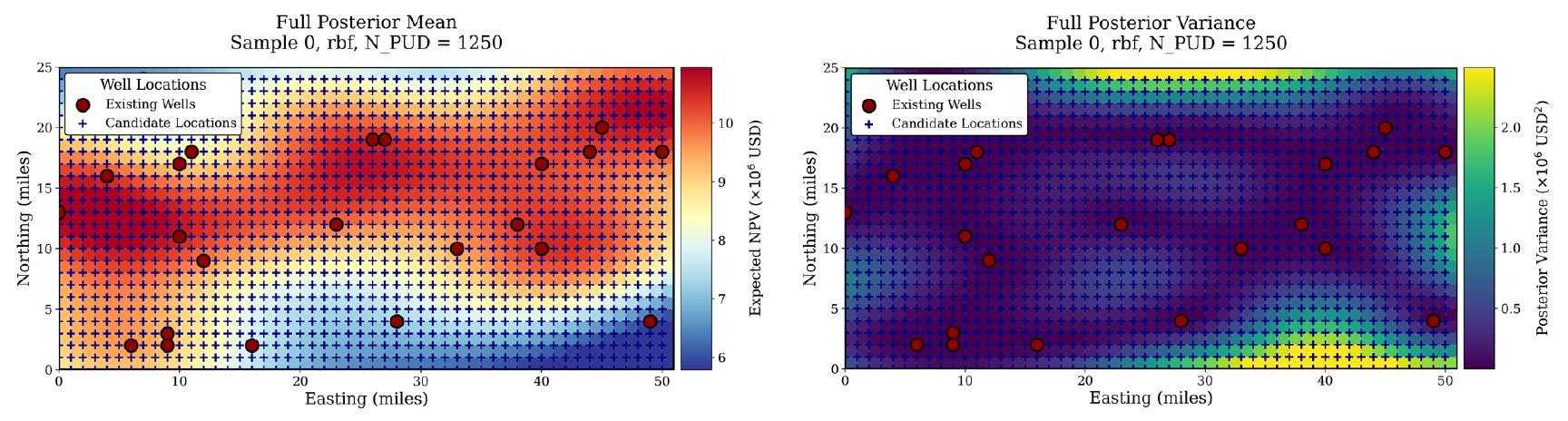
Figure 3. GP posterior maps used to construct candidate-level expected NPV and uncertainty.
Method
- Build geostatistical mean vector
mand covarianceCover candidate wells. - Optimize CARA-normal CE objective as a
0-1QKP: maximizem^T x - (lambda/2) x^T C xwith a cardinality cap. - Replace dense
Cwith RSVD low-rank surrogateC ~= V V^Tto reduce per-node evaluation fromO(N^2)toO(Nr). - Use error bounds to connect CE approximation quality to spectral tail decay and risk parameter
lambda.
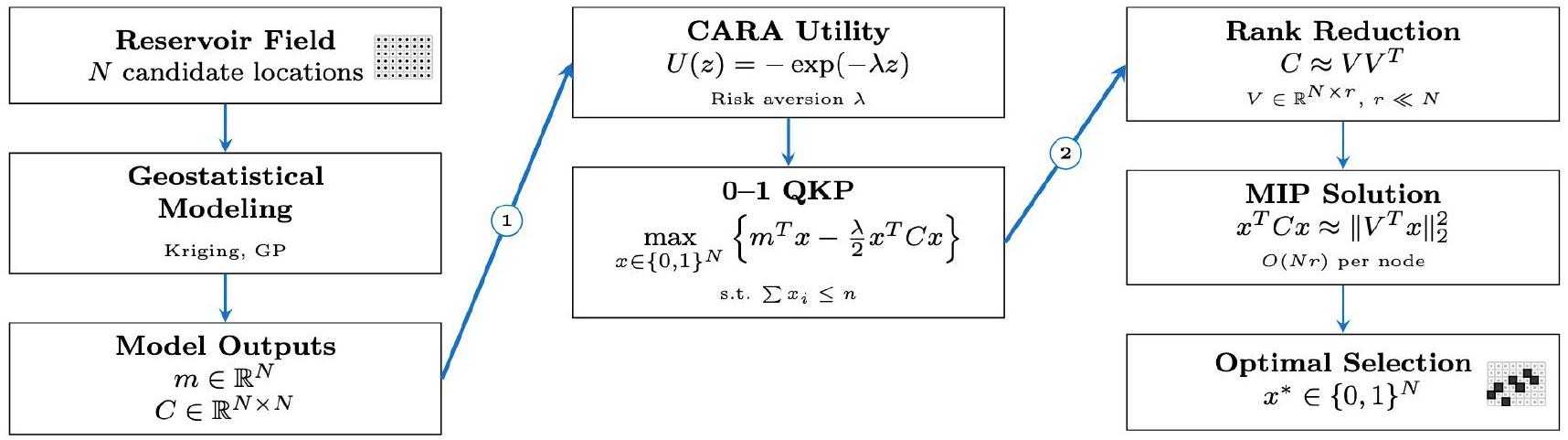
Figure 1. Three-stage workflow: geostatistical inputs, QKP formulation, and RSVD acceleration.
Results
- Across tested synthetic scenarios (
N <= 5,000), RSVD-QKP reports 10x-1,851x speedups. - For practical ranks (
r >= 50), CE gaps stay below 1% across tested kernels and risk levels. - At
r=100, CE gaps are <=0.3% across tested kernels. - In a challenging Matern case,
r=100is about 90x faster than dense QKP with around 0.05% CE gap.
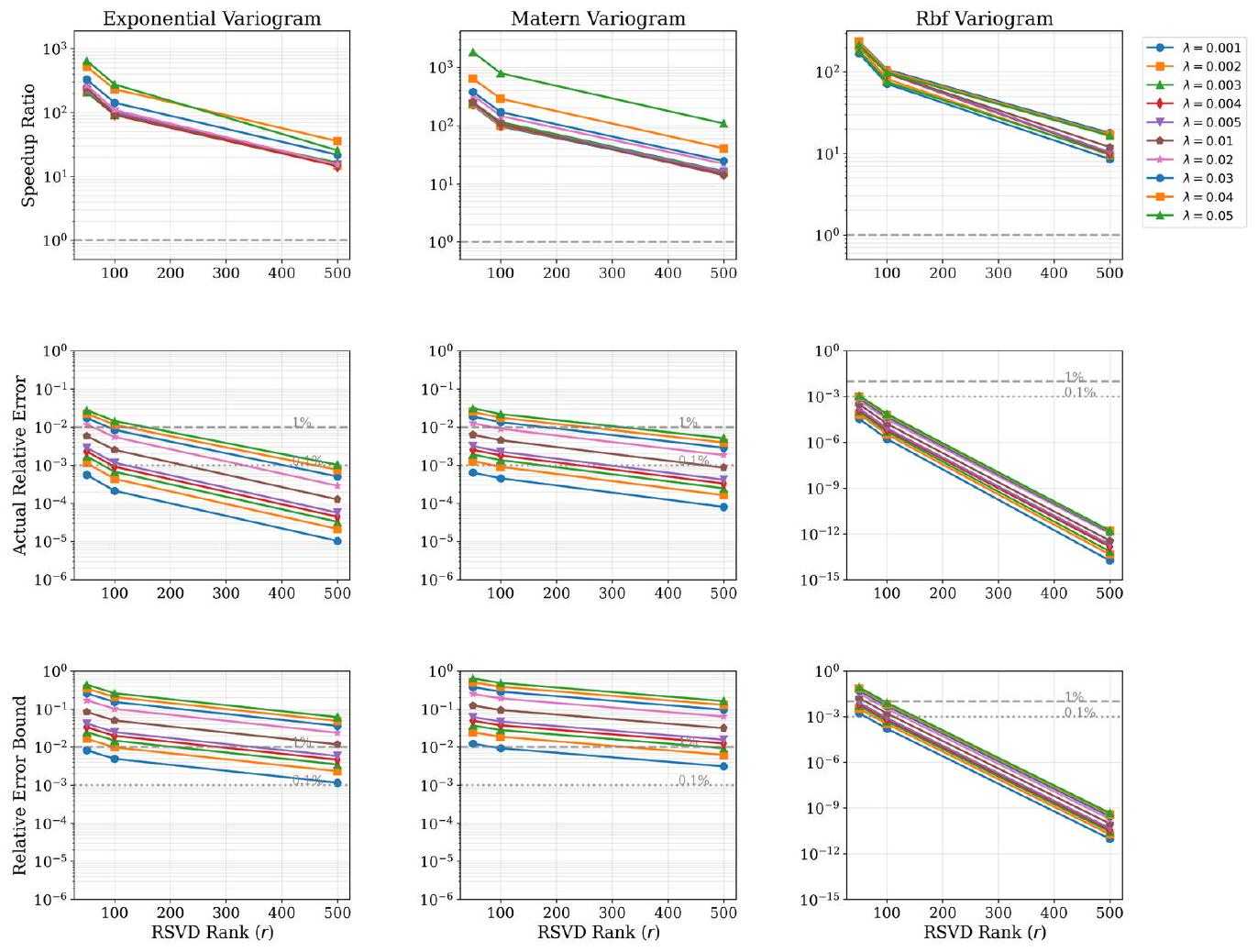
Figure 2. Speedup and CE-error summary across Matern, Exponential, and RBF kernels.
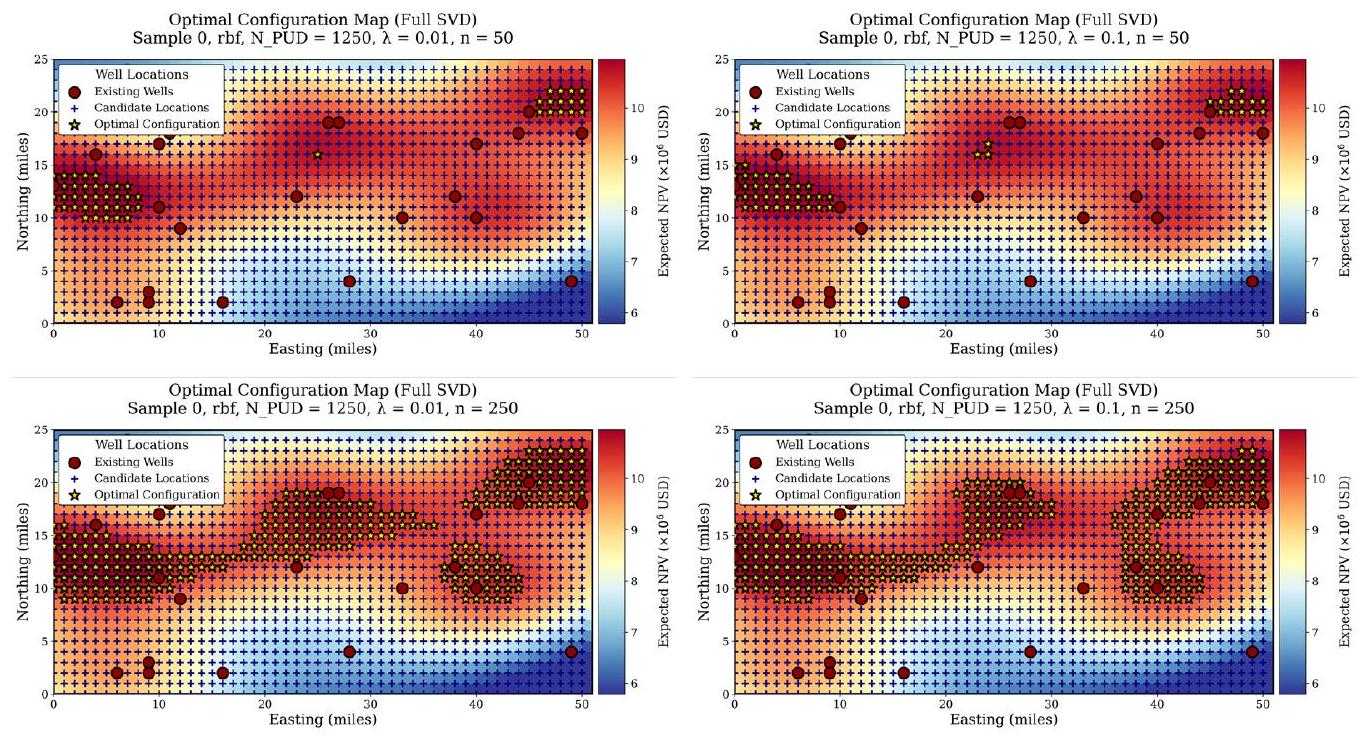
Figure 5. Optimal well-set diversification as risk aversion lambda and portfolio size n vary.
Impact
The method gives asset teams a practical screening tool that preserves risk-awareness, adds optimization certificates (unlike heuristic-only search), and scales to field-sized candidate sets without materially degrading decision quality.
Citation
@article{farell2026scalable,
  title   = {Scalable Risk-Averse Well-Placement Optimization Using Quadratic Knapsack Problem and Randomized Singular Value Decomposition},
  author  = {Farell, R. and Bickel, J. E. and Bajaj, C.},
  journal = {SPE Journal},
  volume  = {31},
  number  = {01},
  pages   = {480--496},
  year    = {2026},
  publisher = {OnePetro}
}