
Measure
Recover motion and geometry
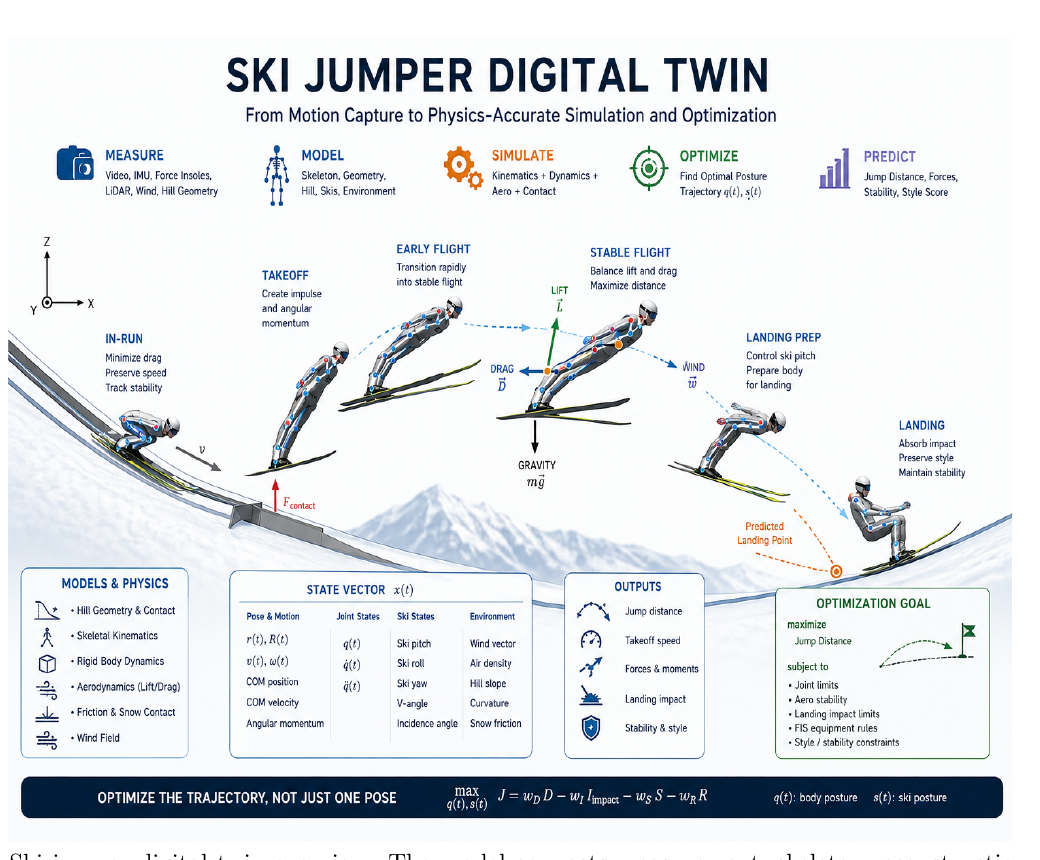
Video, IMUs, force insoles, LiDAR, wind, and hill geometry become time-indexed evidence for the digital twin.

World Models / Sports dynamics / Trajectory optimization
From motion capture to physics-aware simulation, the model optimizes a full body-and-ski trajectory rather than a single pose.
Based on the July 2026 Ski Jumper / Human Digital Twin report. This page presents the proposed model contract and claim boundary for future simulation work.
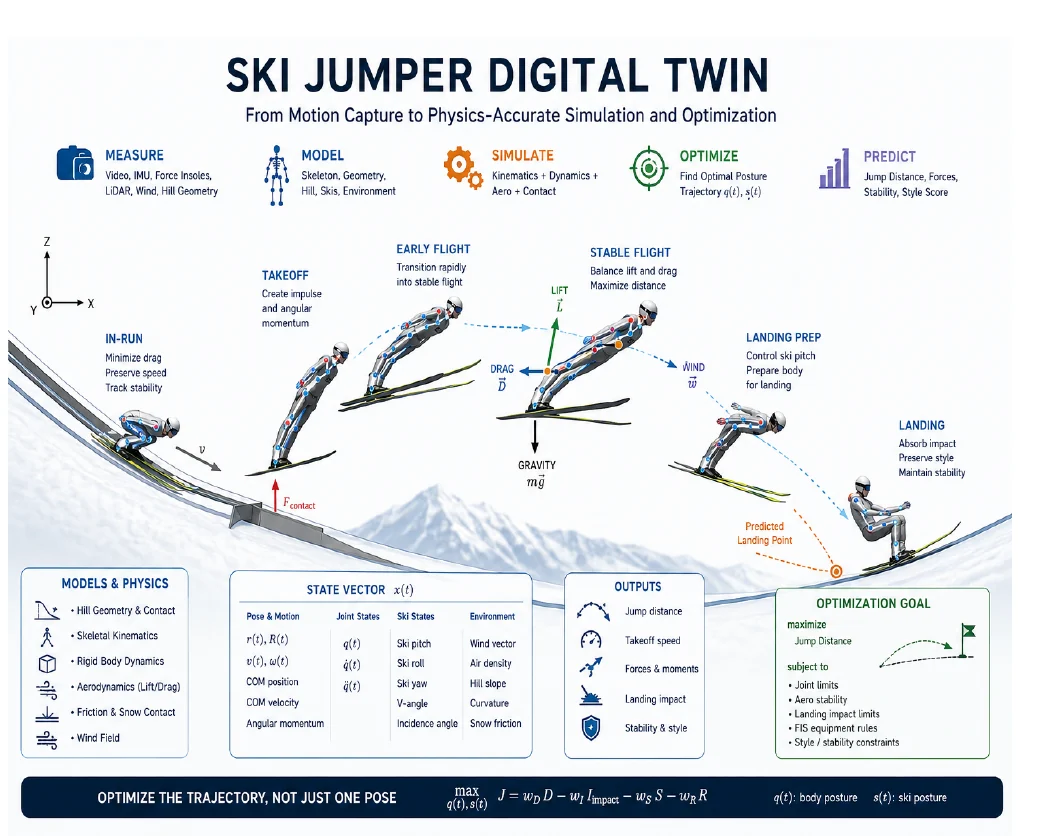
Optimize the trajectory, not one pose
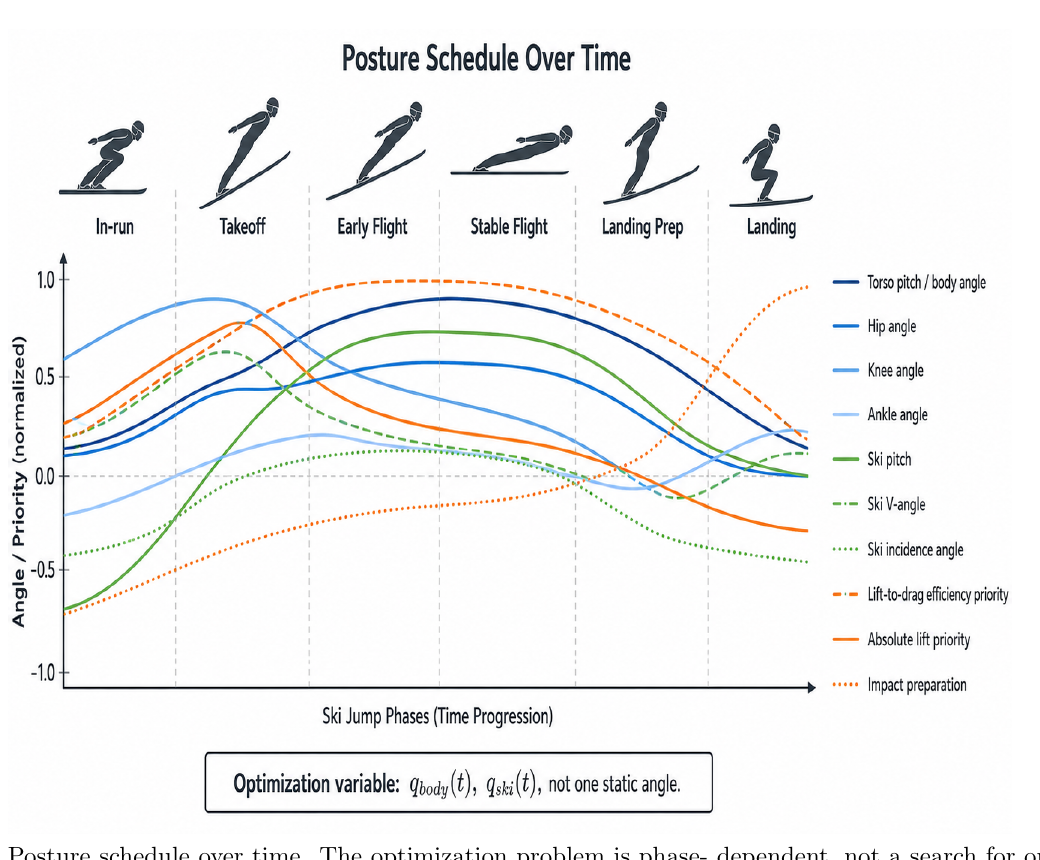
The same body has different objectives on the in-run, at takeoff, in early flight, during stable flight, before landing, and at contact. The twin makes the hill, skeleton, skis, forces, and phase label explicit so those objectives can be simulated and optimized together.
Measure
Video, IMUs, force insoles, LiDAR, wind, and hill geometry become time-indexed evidence for the digital twin.
Model
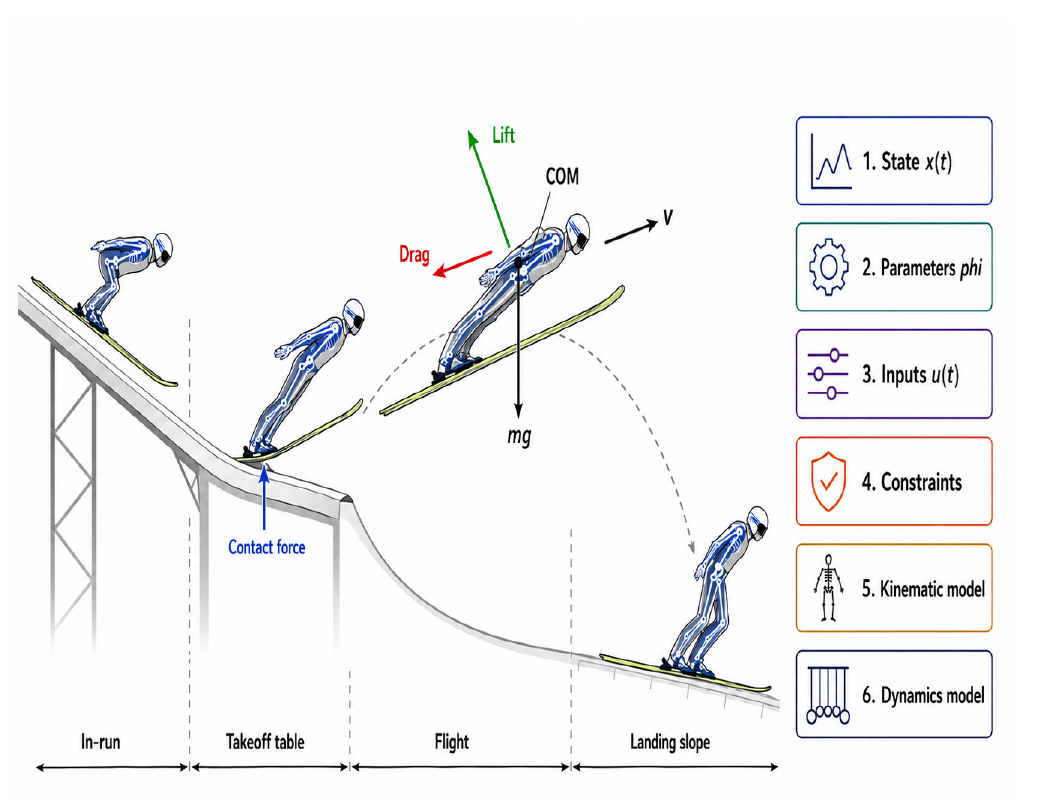
State, parameters, inputs, constraints, kinematics, and dynamics define what the simulator can answer and what it cannot.
Simulate
Forward kinematics produce velocities, accelerations, center-of-mass paths, contact loads, and aerodynamic moments.
Optimize
The objective trades landing distance against impact, instability, rule violations, excessive effort, and unrealistic motion.
Visual map
These views keep the project grounded: a full pipeline, a phase schedule, and a concrete contract for the state and dynamics.
 (opens the full-size image in a new tab)
 (opens the full-size image in a new tab)
 (opens the full-size image in a new tab)
Workflow
A world model becomes useful when the changing objective is visible across time. Each phase contributes a distinct constraint or target to the trajectory.
Preserve speed while reducing drag and maintaining track stability.
Create release velocity and angular momentum through contact impulse.
Reach a stable V-style posture while controlling pitch, roll, and yaw.
Balance lift, drag, ski incidence, and aerodynamic efficiency.
Prepare ski attitude, center of mass, and leg posture for contact.
Absorb impact while preserving alignment, style, and safety.
Technical view
The report treats a static figure as the beginning of an inspectable object. Each stronger physical claim requires a stronger evidence layer and an explicit dynamics model.
The state includes root pose, joint angles and rates, center-of-mass position and velocity, ski orientations, and a phase label. Parameters include segment masses, inertias, equipment, hill shape, wind, and friction.
Forward kinematics produce segment positions and Jacobian velocities. Adding mass, inertia, gravity, contact, and aerodynamic loads yields a bridge to inverse dynamics.
Static geometry supports visual pose. Time-indexed motion supports animation and kinematics. Forces and performance require inertias, contact and aero models, and validation data.
Current scope
The project turns ski jumping into a queryable simulation problem: expose the hill, skeleton, equipment, forces, and phase transitions, then optimize a physically meaningful trajectory under safety and rule constraints.