

A Prior-Robust Sensitivity and Factorial-Necessity Analysis of Tri-Modal Viral-Ultrasound Gene Delivery for Lysosomal Neurodegeneration
1Westwood High School, Round Rock Independent School District, Austin, TX 2Oden Institute for Computational Engineering and Sciences, The University of Texas at Austin, Austin, TX
Abstract
Global sensitivity analysis identifies which parameters of a stochastic biological model drive outcome variance, but variance-based indices are sensitive by construction to each input's prior width, so a dominant index can reflect a calibration choice rather than the underlying biology. We present a four-part audit protocol for distinguishing these two explanations — convergence verification, prior-specification robustness, structural saturation analysis, and factorial intervention-necessity testing — and demonstrate it on a 17-state stochastic model of tri-modal (substrate-reduction, AAV gene, and focused-ultrasound) therapy for GM2 gangliosidosis, chosen because an initial, as-documented analysis indicates BBB-entry kinetics dominate terminal substrate variance (), supporting delivery-focused engineering over enzyme optimization; this entry-rate parameter, however, shares the widest relative uncertainty band assigned to any input tier, raising the possibility that its dominance is a calibration artifact rather than biology.
The saturation step (a 25-point continuous sweep) shows terminal substrate burden is insensitive to this parameter across twelve orders of magnitude, indicating a saturated regime at the calibrated dose. The robustness step (re-analysis under two corrected prior specifications) consistently identifies enzyme-kinetics parameters (synthesis, catalytic decay, capacity, Michaelis constant) as dominant instead, a pattern holding across ten disease parameterizations. The necessity step (a matched-seed factorial analysis) shows focused-ultrasound (FUS)'s contribution to combination therapy is statistically detectable but practically negligible and time-dependent, a conclusion that itself proves robust to a literature-bounded alternative acoustic mechanism.
These results identify enzyme-kinetic parameters, not BBB-entry kinetics, as the highest-leverage within-model bottleneck under the tested assumptions, illustrating how the protocol can overturn a sensitivity-derived conclusion using only convergence, input-specification, and structural checks — no new experimental data. External comparisons revealed substantial absolute-prediction disagreements for untreated natural history, AAV monotherapy, and SRT monotherapy; the reported reversal should therefore be interpreted as a within-model sensitivity and necessity audit, not a validated therapeutic prioritization.
In Plain Terms
Children with GM2 gangliosidosis (Tay–Sachs and Sandhoff disease) lack an enzyme needed to clear a fatty molecule from brain cells, and the infantile disease is fatal. Our earlier computer model of three combined therapies suggested the biggest obstacle was getting therapy across the barrier that protects the brain from the bloodstream. That conclusion turned out to depend heavily on how much uncertainty was assigned to the barrier-crossing step — the part of the model least constrained by published data.
Recalculating with careful, consistent assumptions reversed the conclusion: at the modeled dose, barrier crossing already works essentially at its ceiling, and the real bottleneck is how efficiently the replacement enzyme breaks down the harmful molecule once it arrives. The same pattern held across the other lysosomal disorders we tested. The broader lesson for disease models: a headline sensitivity result can reflect which assumptions were given the most room for uncertainty, and should be checked before it guides real experiments.
From Initial Claim to Corrected Finding
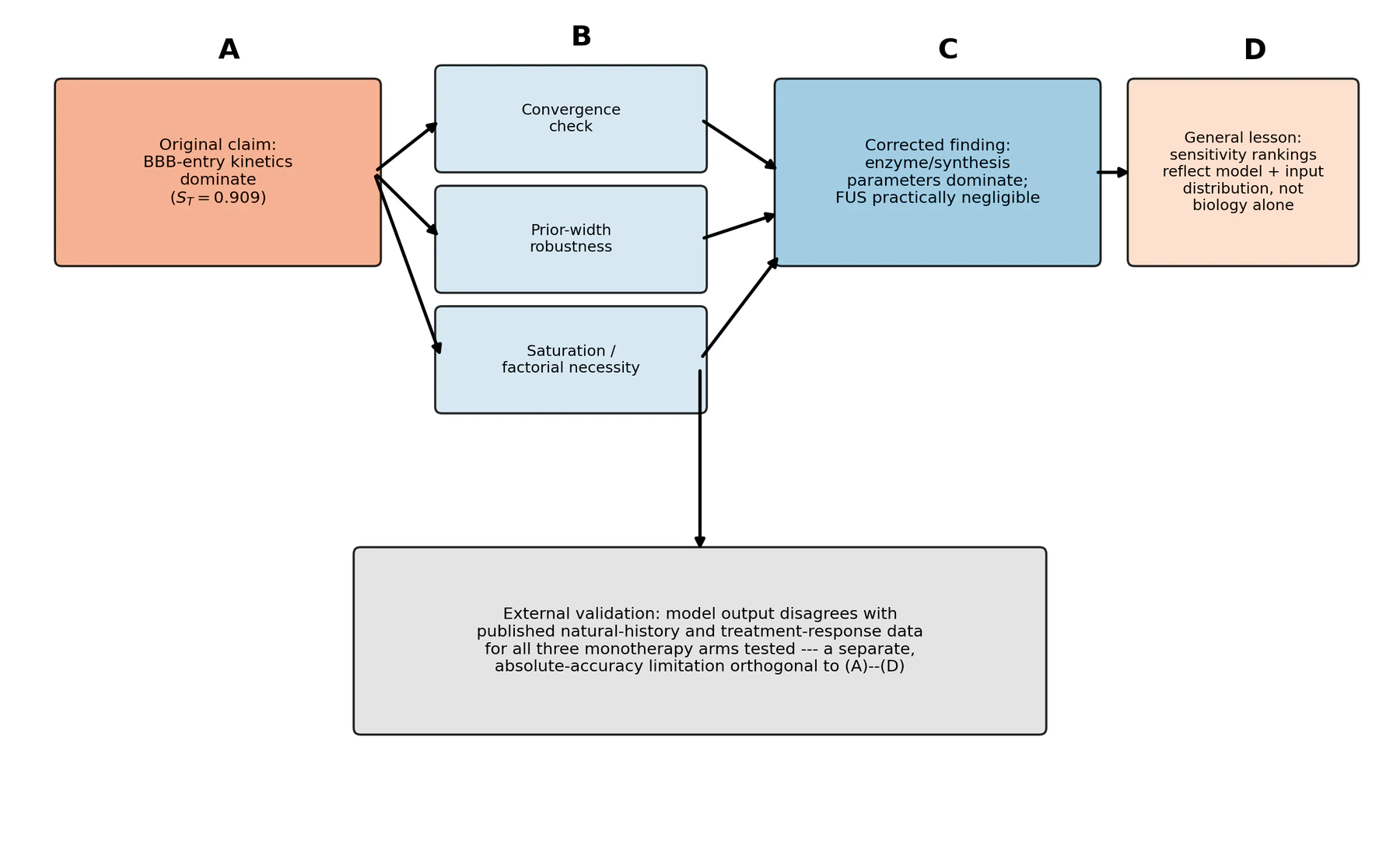
Figure 1. (A) The initial, as-documented analysis. (B) Three independent audit checks: convergence, prior-width robustness, and saturation / factorial necessity. (C) The corrected finding these checks converge on. (D) The general methodological lesson. Separately, external validation against published data (bottom) identifies absolute-accuracy limitations that are orthogonal to, and do not resolve, the audit logic in (A)–(D).
The Four-Part Audit Protocol
Each step answers a different question. Conflating them is a common source of misinterpretation in sensitivity-based biological modeling.
Are the indices numerically stable?
- Sobol total-order indices at –
- Top-five ranking unchanged for
- Bootstrap SE below 0.01 by , the production size
Does the ranking survive corrected priors?
- As-documented, equal-width, and Tier-1-promoted input distributions
- Same estimator, sample size, and seed across scenarios
- Repeated for ten disease parameterizations
Is the parameter at a ceiling?
- 25-point sweep of over twelve orders of magnitude
- 50 stochastic realizations per point
- Local elasticity
Is the intervention needed at all?
- Full -arm factorial over SRT, AAV, and FUS
- 200 matched-seed realizations per arm, paired contrasts
- Shapley attribution at days 45, 90, 180, and 365
| Analysis stage | Parameters | Interpretation | ||
|---|---|---|---|---|
| Original, pre-audit | unconfirmed | unconfirmed | 0.909 | Delivery-dominant claim |
| Recomputed as-documented | 256 | 0.039 | Entry no longer dominant | |
| Equal-width | 256 | 0.001 | Prior-width correction | |
| Tier-1-promoted | 256 | 0.004 | Evidence-tier correction |
The pre-audit sampling configuration is not recoverable, so 0.909 is treated only as the motivating claim. All conclusions rest on the three recomputed analyses, which share an identical , configuration and differ only in prior specification.
BBB Entry Is Already Saturated
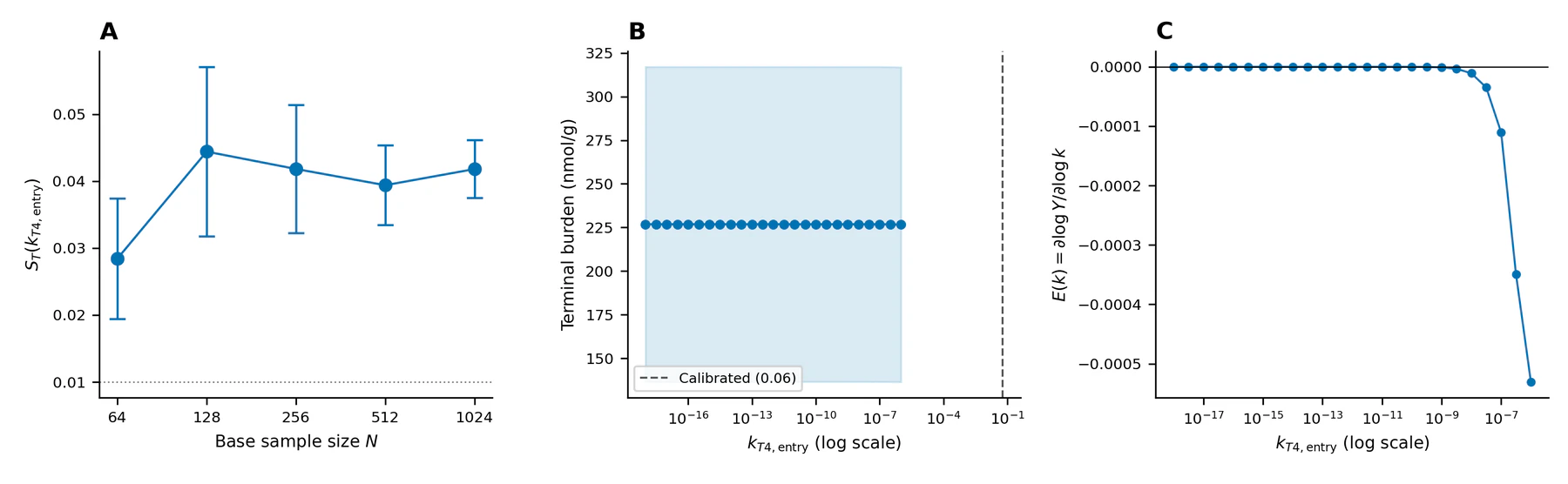
Figure 2. (A) Total-order Sobol index for across – with bootstrap standard errors (); the estimate stabilizes from . (B) Terminal substrate burden across a 25-point log-spaced sweep of ( to , 50 realizations per point); burden changes by less than 0.1% (226.83 → 226.63 nmol/g). The calibrated value (dashed line, 0.06) sits in the same saturated regime. (C) Local elasticity stays within of zero.
At the administered AAV dose, the entry pathway runs far faster than the timescale over which the rest of the system evolves. The entry rate is therefore numerically irrelevant to the outcome across its full range of biologically plausible uncertainty, and no Sobol analysis at realistic widths can detect entry-rate sensitivity in this model — whatever the sample size. Delivery is still necessary: driving returns the model to the untreated baseline. It is simply already sufficient.
Enzyme Kinetics Dominate Under Every Prior Specification
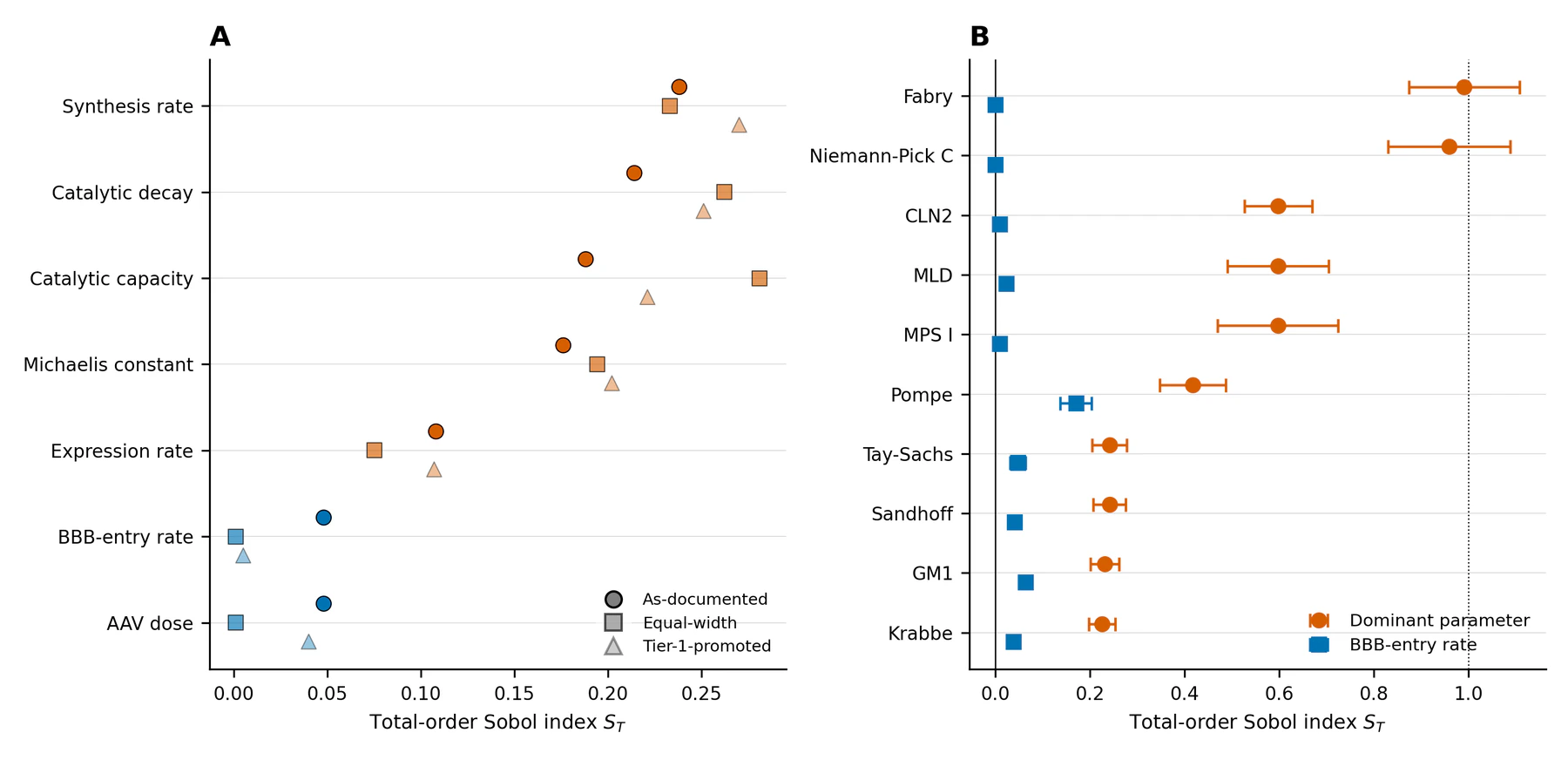
Figure 3. (A) Total-order Sobol indices for the audited GM2 parameters under three prior specifications (marker shape encodes scenario; delivery-related parameters in blue, enzyme/synthesis parameters in vermillion). (B) Each disease's dominant parameter (vermillion) versus its BBB-entry rate (blue), with bootstrap 95% confidence intervals, across all ten disease parameterizations. The dotted line at marks the theoretical upper bound.
| Parameter (GM2) | As-documented | Equal-width | Tier-1-promoted |
|---|---|---|---|
| Synthesis rate | 0.237 | 0.260 | 0.250 |
| Catalytic decay | 0.221 | 0.242 | 0.232 |
| Catalytic capacity | 0.222 | 0.245 | 0.235 |
| Michaelis constant | 0.185 | 0.206 | 0.198 |
| Expression rate | 0.101 | 0.097 | 0.102 |
| Total AAV dose | 0.058 | 0.001 | 0.038 |
| BBB-entry rate | 0.039 | 0.001 | 0.004 |
| IC50 | 0.003 | 0.003 | 0.003 |
| FUS permeability gain | 0.000 | 0.000 | 0.000 |
Total-order Sobol indices, full nine-parameter set with nonzero sensitivity. Bootstrap percentile 95% intervals are reported in the manuscript (Table 4).
The five enzyme-kinetics and synthesis parameters occupy – in every scenario, while the four delivery- and dose-related parameters stay lowest-ranked — including in the as-documented configuration — and the margin between the two classes widens under both corrections. Across Tay–Sachs, Sandhoff, Pompe, Krabbe, GM1, MPS I, MLD, CLN2, Niemann–Pick C, and Fabry, an enzyme-kinetic or synthesis parameter dominates in nine of ten cases. Pompe is the interpretable exception: total AAV dose, not entry rate, dominates (–), consistent with known dose-titration considerations in Pompe enzyme-replacement therapy.
Sensitivity Is Not Necessity: The Factorial Test
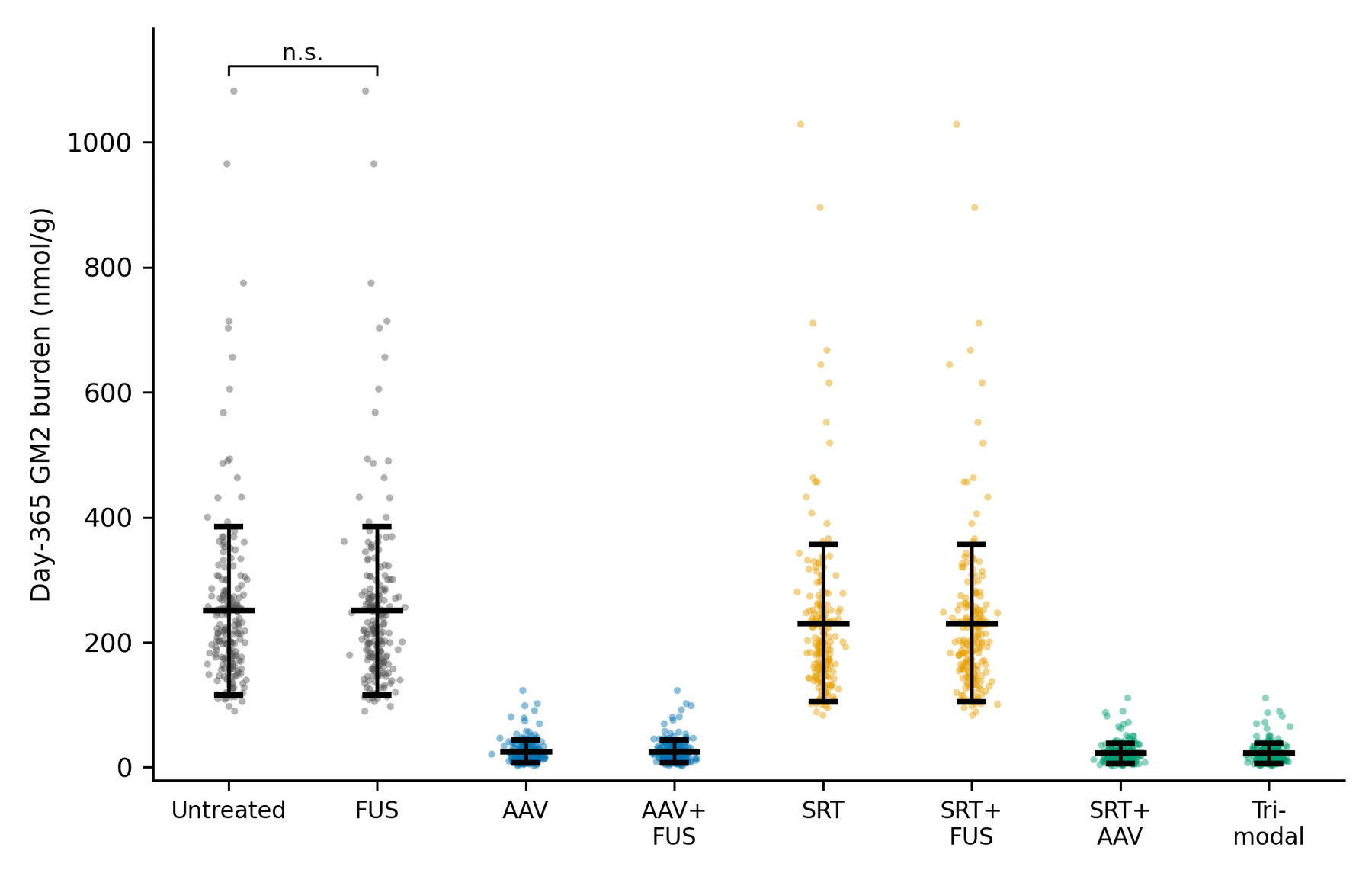
Figure 6. All per-seed day-365 GM2 burden realizations for each of the eight intervention combinations (jittered for visibility), with mean ± one standard deviation. Adding FUS to any arm leaves the distribution essentially unchanged.
Sobol and Shapley indices ask whether varying a parameter changes the outcome given an intervention is active; they never switch the mechanism off. The full factorial design does. Every paired FUS contrast at day 365 has a 95% confidence interval that excludes zero, but the largest effect (−0.032 nmol/g) is 1.3% of a pre-defined practical-equivalence threshold of 2.51 nmol/g — two to three orders of magnitude smaller than the effect of AAV or SRT themselves. FUS is therefore statistically detectable but practically negligible by one year.
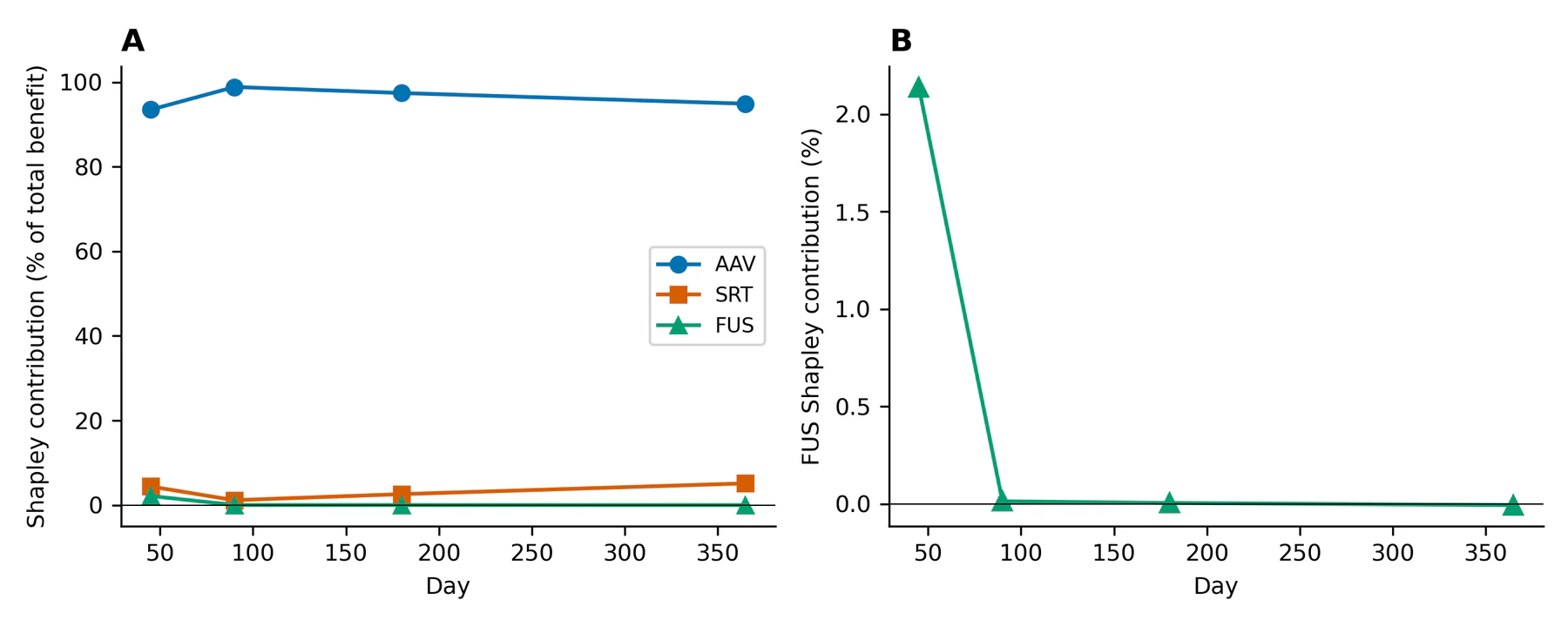
Figure 5. (A) Shapley-attributed share of total tri-modal benefit for AAV, SRT, and FUS at days 45, 90, 180, and 365 (day 365: AAV 94.88%, SRT 5.12%). (B) FUS alone: a small, real early contribution (2.14% at day 45) that decays and turns slightly negative by day 365.
The early-but-fading FUS contribution is consistent with a model in which FUS multiplies an entry rate that is already saturated once AAV or SRT is active, and whose benefit fades as AAV expression itself wanes after its peak around day 250–300. The conclusion holds when the FUS gain is recomputed from a literature-bounded, infant-permissive acoustic threshold. We treat the time course as a model-specific interaction requiring further mechanistic verification.
What This Does — and Does Not — Claim
The paper does not claim that BBB delivery is biologically unimportant, that focused ultrasound is ineffective in vivo, or that enzyme engineering should be clinically prioritized without experimental validation. It shows that, in this simulator and parameter regime, the original delivery-dominant Sobol conclusion is not robust to convergence, input-width, saturation, and factorial-necessity checks.
External comparisons found real disagreements with published data in all three monotherapy arms tested — untreated natural history, AAV monotherapy, and SRT monotherapy. These limit confidence in the model's absolute predictions, not its relative-sensitivity structure. FUS is represented as a scalar gain on entry and uptake rates in a lumped, non-spatial configuration; the findings do not extend to spatially resolved acoustic delivery. Structural model uncertainty (for example, alternative functional forms to Michaelis–Menten kinetics) is left to future work.
Computation was performed on Lonestar6 at the Texas Advanced Computing Center.
People
- Chandrajit Bajaj
- Kartheek Nekkanti