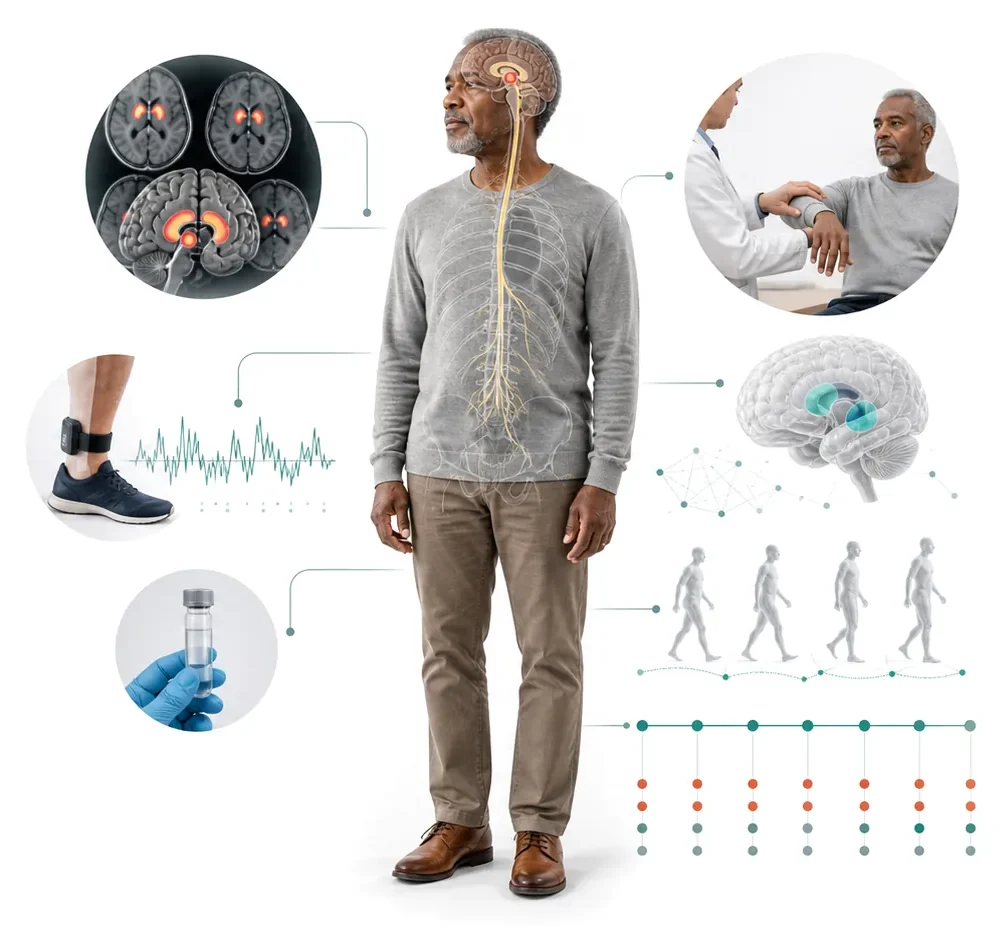
Parkinson's reaches well beyond tremor, and the evidence about any one patient arrives scattered across clinic visits, imaging, biomarkers, wearables, genetics, and the health record. AI4PD assembles that evidence into one living, uncertainty-aware model of the patient, so that clinicians work from the individual record rather than the population average, and every output goes to the physician first.
Oden Institute · The University of Texas at Austin · CVC Lab · TACC infrastructure · Supported by the Michael J. Fox Foundation
Patient portal
Making the invisible visible
An interactive portal for clinicians: enter a patient's data and watch personalized motion and gait on an anatomical model, driven by PPMI metrics and wearable sensor signals rather than a population template.
Research evidence for clinicians and partners; not a clinical decision tool.
Personalized modeling
Patient-specific inference instead of population averages. Clinicians enter one patient’s data and see that patient’s motion and gait modeled on an anatomical figure.
Built for the clinic
An interactive tool that saves clinician time and is built for accuracy and reliability, so physiological dynamics become something you can see, compare, and question.
A living showcase
The same portal demonstrates tangible progress to proposal reviewers and philanthropic partners: not a slide, the working system.
Evidence to date (retrospective)
What the analyses show
Preprints, an accepted conference paper, and two manuscripts on established Parkinson's cohorts (PPMI, BioFIND, PDBP, FoxInsight, S4). The headlines are below; full cohorts, methods, and limitations are on the Evidence page. These results are retrospective and hypothesis-generating: the calibrated substrate the twin is built on, not the mechanism claim itself.
Calibrated motor states · PPMI + BioFIND
Motor phenotyping that reports its own overconfidence
Across 29,366 PPMI visits from 4,773 patients, motor states stay stable on average yet 25.5% of patients shift over time, and the model discloses its overconfidence (0.989 nominal vs 0.849 empirical) instead of hiding it.
Across 5,404 future-only cutoffs from 1,058 PPMI participants, a small internal increment survives participant separation but fails calendar and transport gates, so the protocol stops the claim before deployment language begins.
Signed dopaminergic asymmetry tracks the opposite body side
Keeping the left–right sign of putamen binding recovers reproducible contralateral anatomy in PPMI (r = 0.676) and an independent S4 cohort (r = 0.551), and adds modest future side-balance information.
LRRK2 risk and wearable gait, in one stratification
LRRK2 G2019S carries a 1.92× PD prevalence ratio and +4.35 motor points; wearable arm-swing asymmetry (27%) and a risk model (AUC 0.717) add scalable digital signal.
Underneath those results sits the patient-specific digital twin. Its interpretable core is a structured prior for how a patient's state evolves, with functional reserve, coupling between subsystems, dissipation, and therapy ports, not a claim of physical energy conservation, and it updates as new visits, sensors, and biomarkers arrive.
On top of the twin, multi-agent diagnostic and therapy-planning agents reason over a dynamic knowledge network, surfacing disagreement, uncertainty, and gaps rather than smoothing them over. Letting a clinician simulate a candidate DBS change in the twin before changing patient settings is a prospective-validation hypothesis, not a current capability.
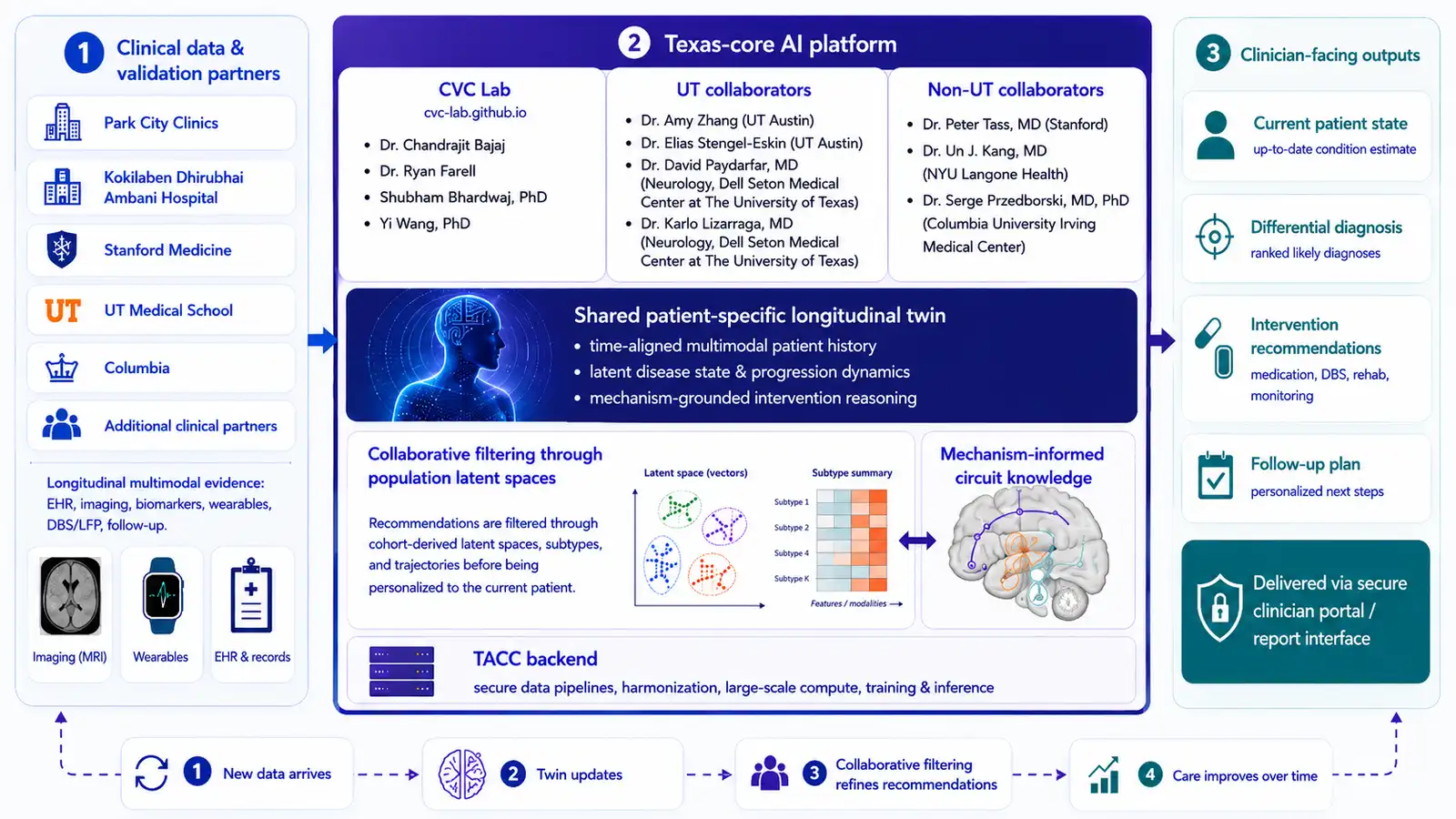
Clinical partners and multimodal evidence feed a Texas-core AI platform; the platform maintains a shared patient-specific twin and returns diagnosis, intervention, and follow-up guidance to clinicians.
One program
Where to go next
Everything about the Parkinson's program lives under this one address: the approach, the clinician workflow, the evidence, the research companion, and how to partner.
How the twin works
Approach
A structure-preserving digital twin organized by a port-Hamiltonian core, fed by four method thrusts, with modality-specialized agents and evidence arbitration on top.
AI4PD is decision support, never an autonomous prescriber, and its hardest constraint is not the model. It is the multi-institution longitudinal evidence layer needed to validate it. We are looking for movement-disorders neurologists and institutions that govern longitudinal Parkinson's cohorts to partner on clinical data and prospective validation, on terms that meet your standard of proof.