Imaging
DaT-SPECT and T1 MRI run through automated atlas-constrained segmentation and MNI coregistration; per-ROI features fuse with clinical and molecular measures.
Read the brief: Imaging
How AI4PD works
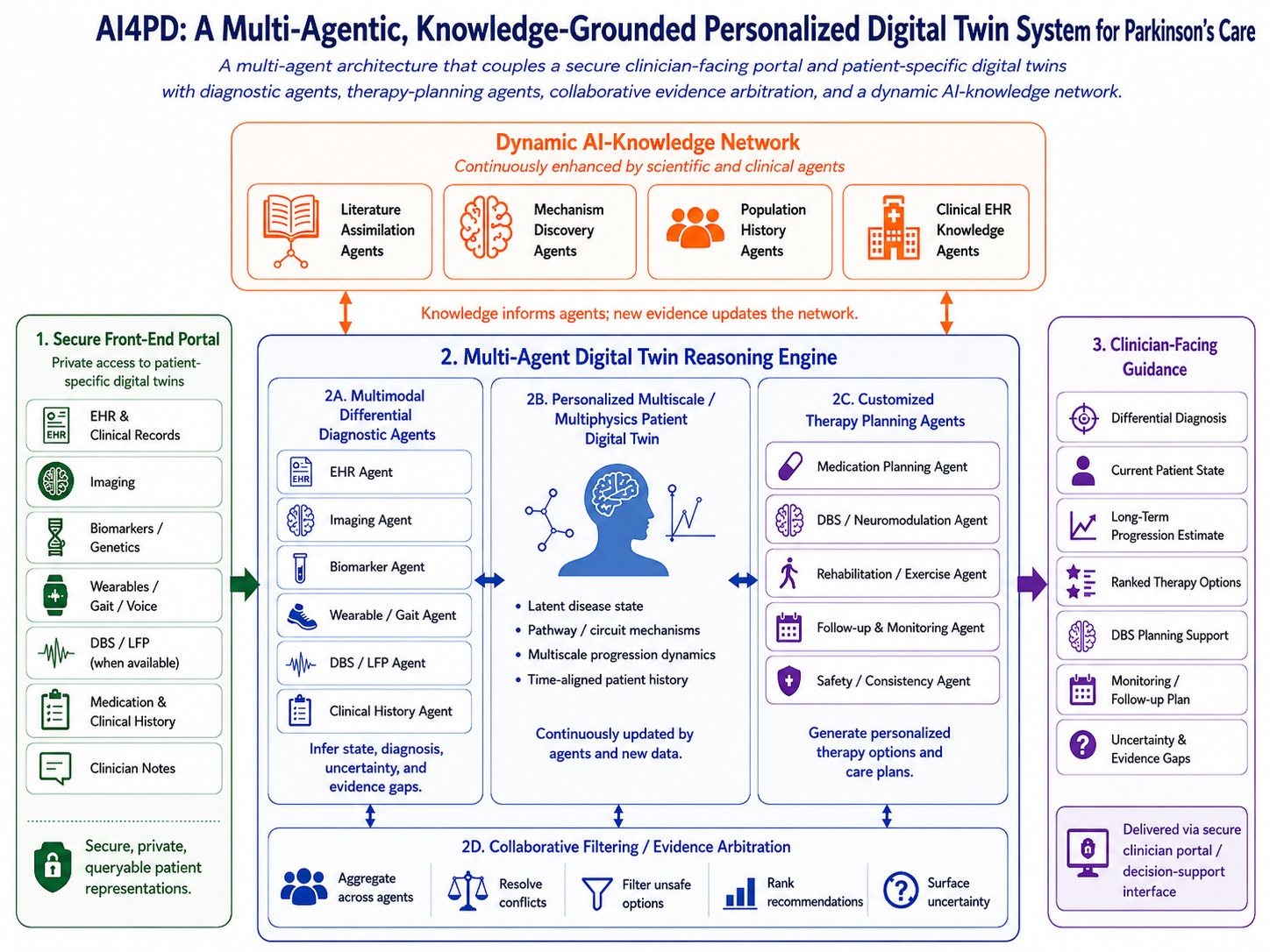
Parkinson's progresses through neural circuits and physiological systems that no single clinical test measures directly. AI4PD frames this as an ill-posed inverse problem: reconstruct a patient's hidden, evolving state from sparse, asynchronous, partially observed evidence. It approaches the problem with a structure-preserving model rather than a black box, which regularizes the reconstruction under stated identifiability assumptions, exposes per-subsystem reasoning to inspection, and is designed to report uncertainty rather than hide it. The empirical results behind each layer live on the Evidence page; this page explains the design.
The living twin
AI4PD is designed to maintain a single longitudinal model per patient and to update it as evidence arrives: a single intake, each clinic visit, a continuous wearable stream, or DBS sessions only. Its dynamics are organized by a port-Hamiltonian core, an interpretable structured prior, not a literal-physics claim.
Parkinson's has no conserved physical energy; the structure is an inductive bias, not a recovery of real physics. What it buys is concrete: bounded, stable forecasts under missing modalities, and interventions expressed as port inputs rather than hidden coefficients. We state the identifiability assumptions explicitly and test whether the structure earns its place with planned ablations against calibrated neural-ODE and unstructured baselines.
Supporting methods: PHAST port-Hamiltonian forecasting; perennial learning.
Inputs
Multimodal evidence has to become analysis-ready features before the twin can reason over it. Four method thrusts do this. Each is a standalone brief with full methods, figures, and references.
DaT-SPECT and T1 MRI run through automated atlas-constrained segmentation and MNI coregistration; per-ROI features fuse with clinical and molecular measures.
Read the brief: ImagingFree-water-corrected DTI is fused with UPDRS and MoCA scores in a robust variational co-clustering framework that aligns microstructural and clinical manifolds into observational subtypes.
Read the brief: Diffusion and clinical co-clusteringAPDM Opal IMUs over sway, TUG, and dual-task walk yield 50+ gait and arm-swing features, combined with cognitive batteries. These help mainly when fused: the gait IMU substudy is roughly 93–100 patients and the integrated risk model is internally validated on n=204 with no external cohort, so treat it as hypothesis-generating.
Read the brief: Wearable and cognitive phenotypingStatistical testing across harmonized PPMI and LRRK2-consortium cohorts associates biomarkers with candidate pathways. These are FDR-controlled, cross-sectional associations and hypotheses for follow-up, not causal claims, and cluster labels are not applied to individual patients.
Read the brief: Mechanism inferenceReasoning
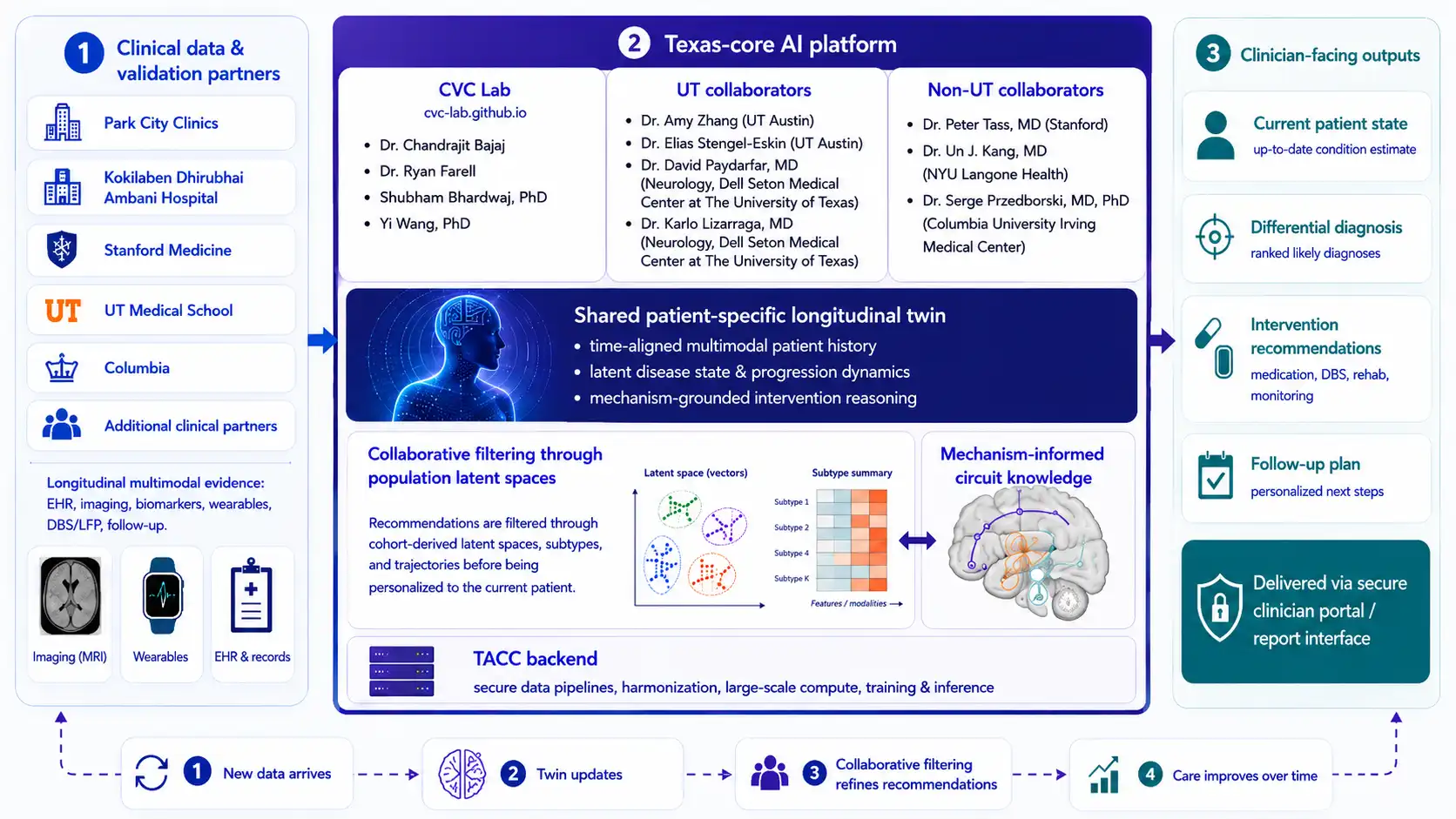
Collaborative-filtering signals, what the model has learned across many patients, sharpen the plausible state space for one new patient, while every candidate stays grounded in that patient's own data, mechanism, literature, and clinical context.
A research direction
At the circuit level, Parkinson's motor signs are associated with pathological beta-band hypersynchrony in the subthalamic–cortical loop, and desynchronization is the therapeutic principle behind deep brain stimulation. Reactive and adaptive DBS have already reached the clinic. This is background motivation, not an AI4PD result.
AI4PD's intended contribution is a planning step: simulate candidate stimulation changes inside the patient-specific twin before any patient setting is changed, a prospective capability still subject to clinical validation. Whether a patient-specific twin can faithfully predict an individual's response to a given stimulation change is itself unproven; any in-twin simulation is a hypothesis to be tested against observed clinical response, never a basis for changing settings on its own. The twin does not set DBS candidacy or stimulation targets and does not prescribe. Framing intervention as controlled movement through structured patient state is a research direction (Hamiltonian control), not a present clinical feature.
What the clinician sees
Using the same population map from the agents above, a new patient can be placed within the population and matched to statistically similar prior cases for context. Latent similarity is not clinical equivalence, and a neighbor's trajectory is not a prognosis for the index patient; retrieved cases are illustrative context, with representativeness and uncertainty reported. Per-patient subgroup assignment is a validation target, not a delivered output. The intended clinician-facing outputs below are validation targets for a system under development, not delivered guarantees:
Interactive view: the patient portal (opens in a new tab) · full walkthrough on the clinician workflow page.
AI4PD is designed as decision support with a human in the loop. Every meaningful output is routed to clinicians first; the system supports diagnosis and therapy planning but does not diagnose or prescribe autonomously, and it does not determine DBS candidacy or stimulation targets. Data remain governed by the contributing institutions, are de-identified, and are analyzed under privacy-preserving safeguards. Clinicians retain every decision; the system narrows the differential and surfaces evidence gaps faster than manual review.