A connected precision-neurology research program

Making hidden structure in Parkinson disease records visible

The same motor score can conceal different anatomy, source timing, missing evidence, and uncertainty. This program asks two linked questions: what patient-specific state is supported by the record, and what must that evidence survive before a scientific claim is allowed to advance?

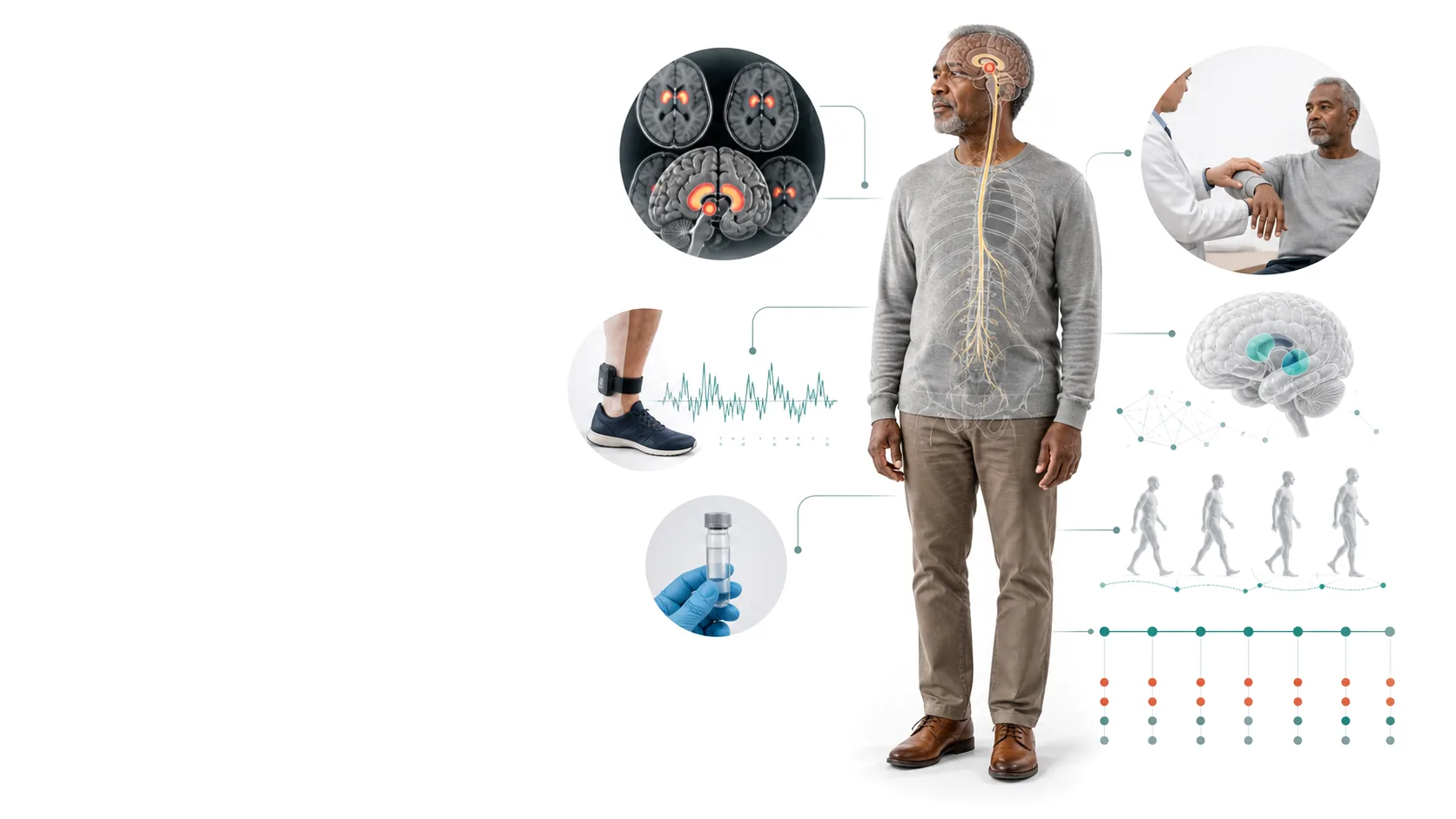
Conceptual adult participant surrounded by clinical examination, DaT-SPECT, wearable gait, biomarker, brain, and longitudinal evidence

Harsh Milind Tirhekar, Priyanshi Yadav, Chandrajit Bajaj

Two complementary journal manuscripts Data-derived, outcome-blind patient histories Research evidence, not a clinical decision tool
Clinical examination DaT-SPECT Wearable gait CSF biomarkers Longitudinal context

Conceptual medical illustration; no participant image or record is shown.

How to read the program

From a dated record to a warranted claim

Multimodal integration is useful only when it preserves where information came from, when it was observed, what it resolves, and what remains uncertain. The work therefore follows one explicit sequence.

1. Observe Keep clinical, imaging, molecular, cognitive, and treatment sources dated and separate.
2. Resolve Retain anatomical direction and cross-source disagreement instead of averaging them away.
3. Test Use future-only outcomes with participant, site, calendar, and uncertainty challenges.
4. Promote or stop Advance only the claim supported by its own biological, predictive, and transport evidence.

Research map

Two scientific rails joined by an evidence-quality spine

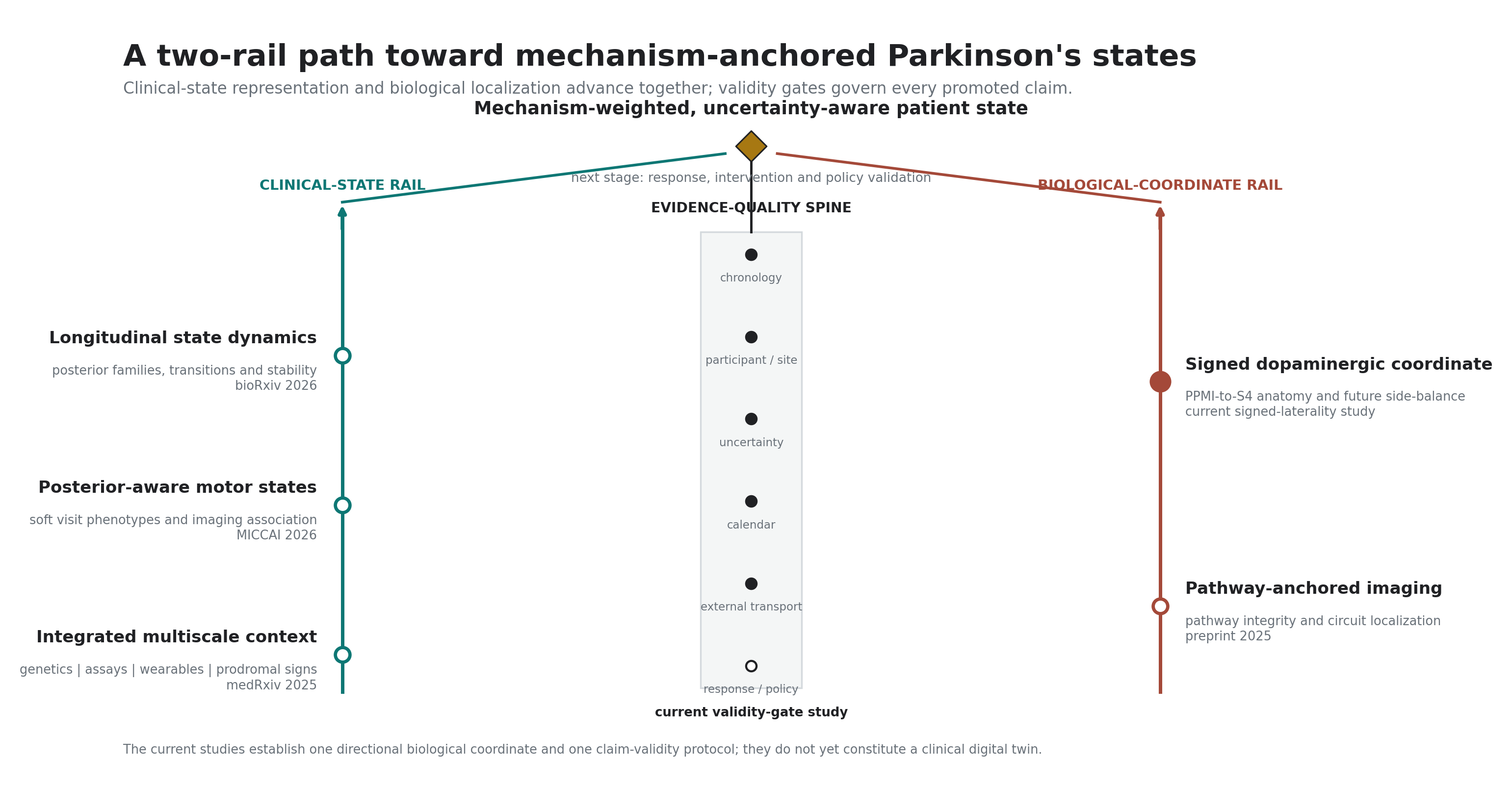
Earlier multimodal stratification and posterior-aware phenotyping establish broad patient-state representations. The current studies separate two questions that should not be collapsed: whether a claim is valid over time, and whether one biological coordinate preserves interpretable anatomy.

Program ladder: phenotype, mechanism coordinate, and validity
Research ladder connecting clinical-state models and biological coordinates through claim-specific validity gates
The clinical-state rail asks how patient heterogeneity should be represented over time. The biological-coordinate rail asks where and in which direction a disease-linked signal is expressed. Their future convergence requires mechanism-weighted uncertainty, not feature accumulation alone.

Current studies

Different endpoints, different claims, one scientific discipline

Paper 1 | Evidence-quality spine

Validity Gates Expose Limits of Longitudinal Multimodal Parkinson Disease Prediction

Question
When may an internal multimodal prediction result be promoted?
Finding
A small internal increment survives participant separation but not calendar and transport gates.
Boundary
Selective uncertainty returns ABSTAIN; clinical utility is not established.
Read the validity study →

Paper 2 | Biological bridge

Signed Dopaminergic Asymmetry Tracks Contralateral Motor Laterality

Question
What is lost when left-right dopaminergic direction is reduced to magnitude?
Finding
Signed anatomy replicates in PPMI and S4 and adds modest future side-balance information.
Boundary
The coordinate is biological evidence, not a calibrated mechanism probability.
Explore the laterality study →

What joins the papers?

Paper 1 decides whether a longitudinal claim is stable enough to advance. Paper 2 shows what a source-aware state can reveal when anatomical sign is preserved. A future mechanism-aware model needs both: patient-state specificity and evidence that remains trustworthy outside the analysis that created it.

Evidence at scale

Large analyses, deliberately bounded conclusions

5,404 future-only prediction cutoffs from 1,058 PPMI participants in Paper 1
8,000 semisynthetic experiments stress-testing the complete validity protocol
1,367 + 56 PPMI and independent S4 participants in the signed biological replication

These studies do not claim clinical deployment, treatment selection, calibrated mechanism probability, or global progression prediction. Their contribution is to expose biological direction, uncertainty, and the conditions under which a claim should stop.