Paper 1 / Longitudinal prediction
Validity Gates Expose Limits of Longitudinal Multimodal Parkinson Disease Prediction
Similar motor scores can sit on very different evidence histories. This study makes those differences visible, then tests whether they support a trustworthy forecast. A small predictive gain is not the same as a clinically useful prediction.
Actual PPMI records / Baseline-selected comparison
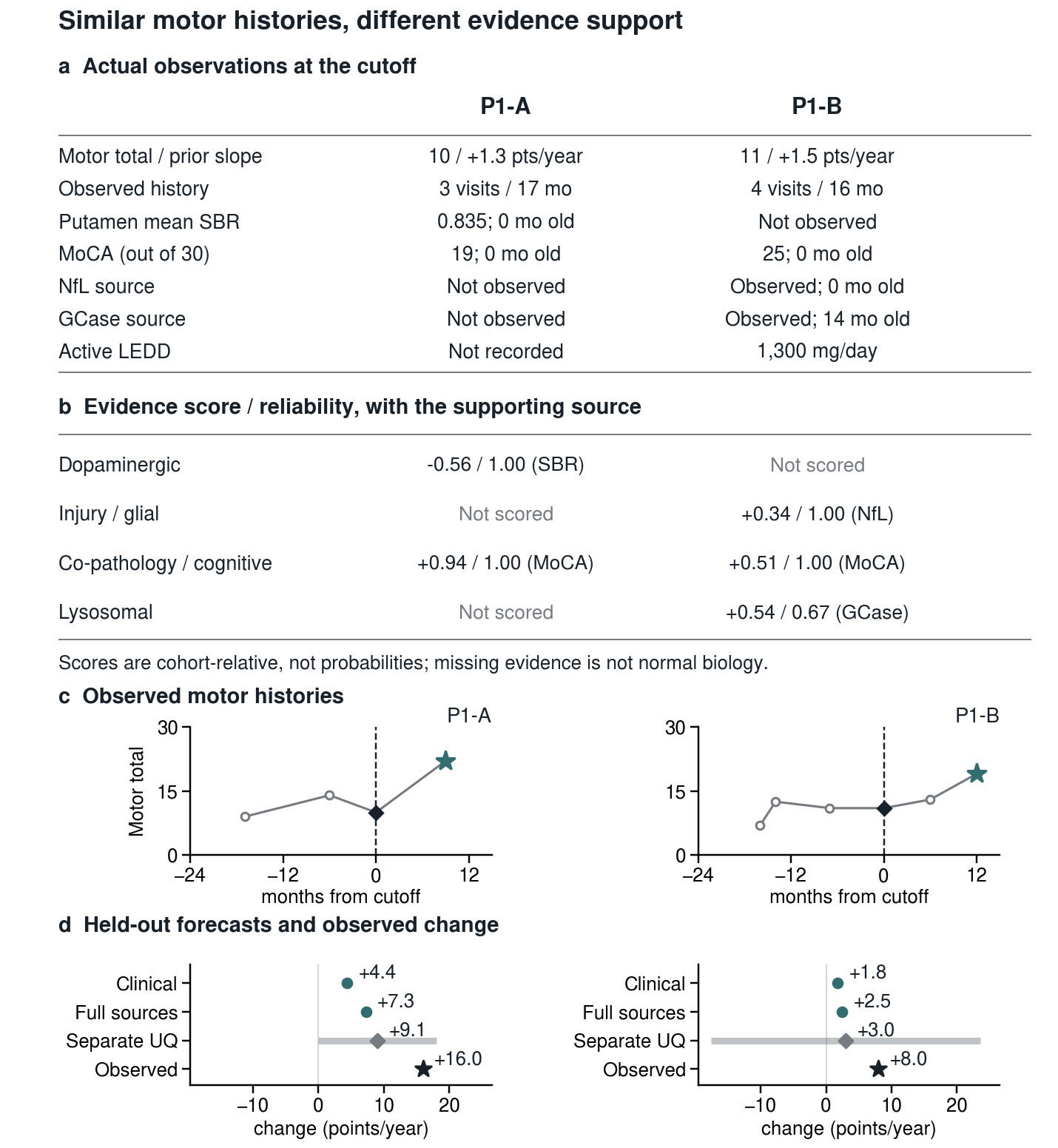
Motor scores of 10 and 11. Different evidence behind them.
P1-A has recent imaging and cognitive measurements; P1-B has no eligible DaT-SPECT value but does have NfL and GCase assay evidence. A missing measurement is not a normal result. Neither record supports a treatment recommendation.
The two complete measured histories are also available in the patient comparison figure.
Selection, score meaning and uncertainty
The pair was selected without future outcomes or forecast errors. The earliest eligible records were matched within sex and analysis fold, with baseline calipers for motor score (3 points), age (5 years), disease duration (2 years) and prior motor slope (2 points/year). The closest clinical pair among 30 candidates was retained. Treatment was not matched; this is an illustration, not a causal comparison.
Evidence coordinates are oriented, training-fold-relative ranks on a scale from -1 to +1, not probabilities or clinical severity grades. Positive values indicate relatively greater evidence on that axis. Reliability summarizes available source weights, with a 24-month age half-life; it is not the probability of a correct forecast. An older source can retain its relative score while losing reliability.
| Measurement and scale | What it contributes | Interpretation limit |
|---|---|---|
| DaT-SPECT SBR: regional imaging | Specific-binding ratio, used as dopaminergic evidence | Not a direct count of surviving neurons |
| MoCA: clinical cognition | Cognitive screening score out of 30 | Not proof of a specific molecular co-pathology |
| NfL: fluid biomarker | Neurofilament light evidence within the injury/glial coordinate | NfL alone does not establish inflammation |
| GCase: enzyme assay | Glucocerebrosidase-related lysosomal evidence | Not a GBA genotype or a treatment-response test |
| LEDD: treatment record | Levodopa-equivalent daily dose and its availability | An absent record does not mean untreated |
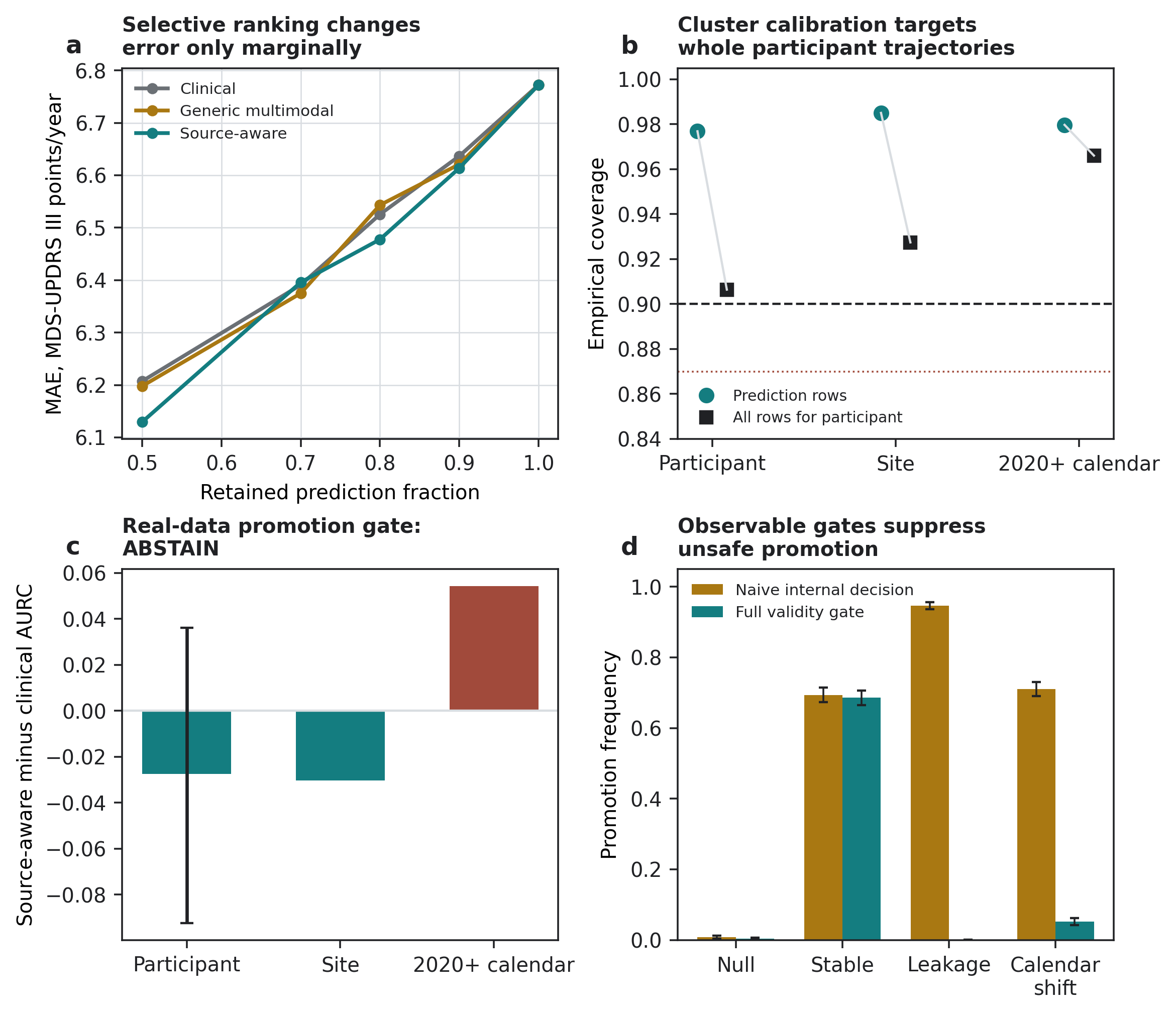
The displayed prediction interval belongs only to the separately fitted nested uncertainty model, not to the main point forecasts. Valid interval coverage did not establish reliable error ranking. The cohort-level selective-uncertainty verdict is ABSTAIN; this is not an individualized diagnosis or a claim that either patient failed a test.
The result at a glance
Seven questions produce seven verdicts, not one headline score
Each gate protects a different claim. Passing chronology cannot rescue failed transport, and correct interval coverage cannot substitute for useful error ranking.
The scientific output is the decision boundary. Dated multimodal history contains a reproducible internal increment, but the effect is clinically tiny, temporally fragile, and not externally transportable in the available export. The protocol therefore stops the claim before deployment language begins.
Study design
Every forecast begins at a dated cutoff
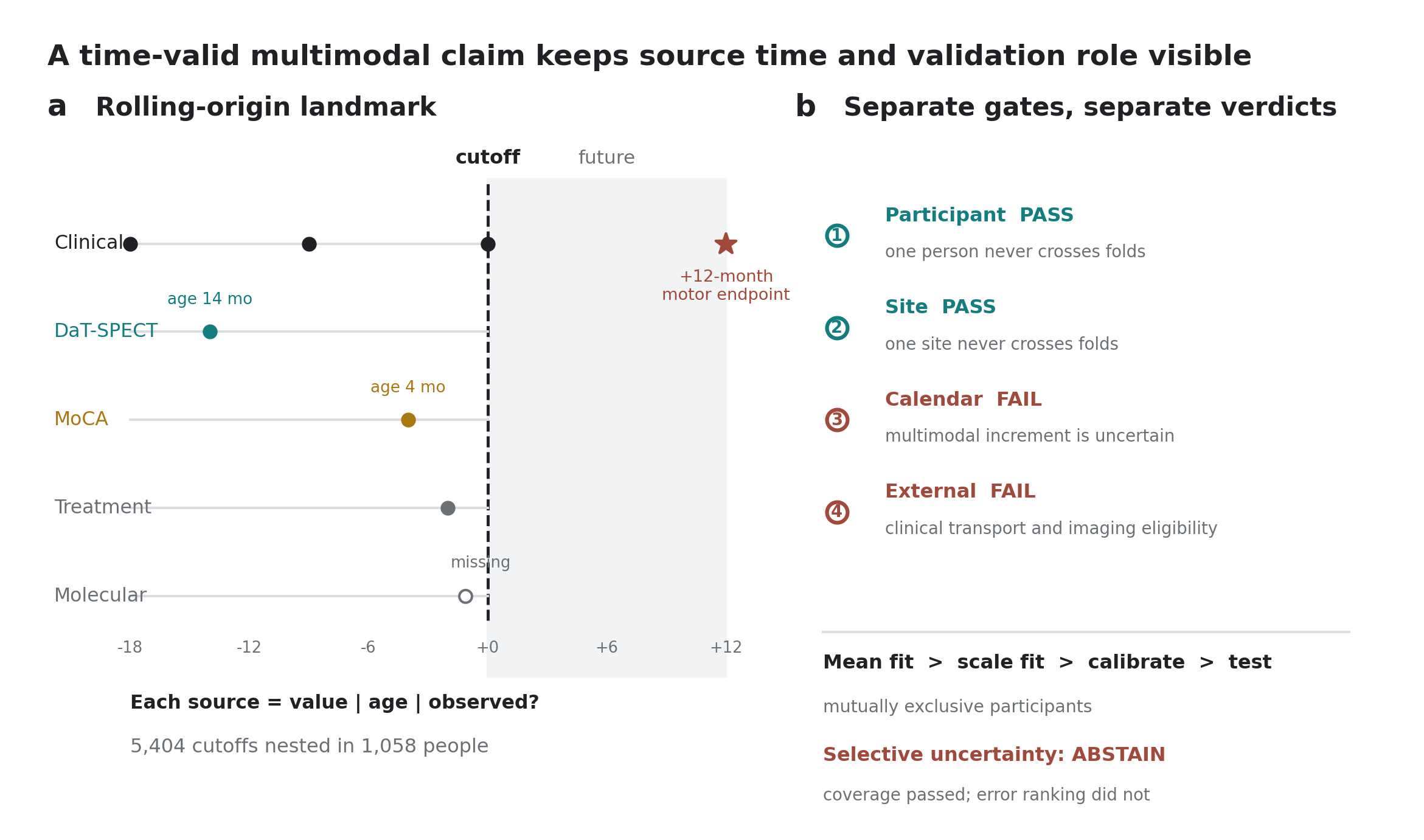
Each patient's record is paused at a dated cutoff. Only measurements already available at that moment may describe the state. Their age and absence remain visible; the future motor examination, 9 to 15 months later, stays hidden until evaluation.
Why ordinary validation is insufficient
A repeated clinical history is not a flat table
The same person appears at multiple visits. A scan may be months older than the examination it accompanies. Missingness may encode a study protocol rather than biology. Medication state changes motor scores, and a new enrollment era can change both who is measured and how sources are collected.
These are different scientific risks. The benchmark therefore assigns each one a distinct population, uncertainty interval, and promotion rule.
| Analysis | Scale | Question it answers |
|---|---|---|
| Rolling-origin benchmark | 1,058 people; 5,404 cutoffs | Do dated sources add internal information when every person stays in one fold? |
| Strict-calendar challenge | 442 later-era participants | Does the frozen relation survive a later enrollment and observation regime? |
| Site-disjoint challenge | 951 people across 52 sites | Is the increment dependent on acquisition center? |
| Gate stress test | 8,000 controlled experiments | Does the protocol suppress false promotion and detect leakage or shift? |
| PDBP clinical transport | 77 calibration; 156 untouched test participants | Does a frozen clinical model travel to an independent cohort? |
Internal result
The signal is measurable; the improvement is not clinically persuasive
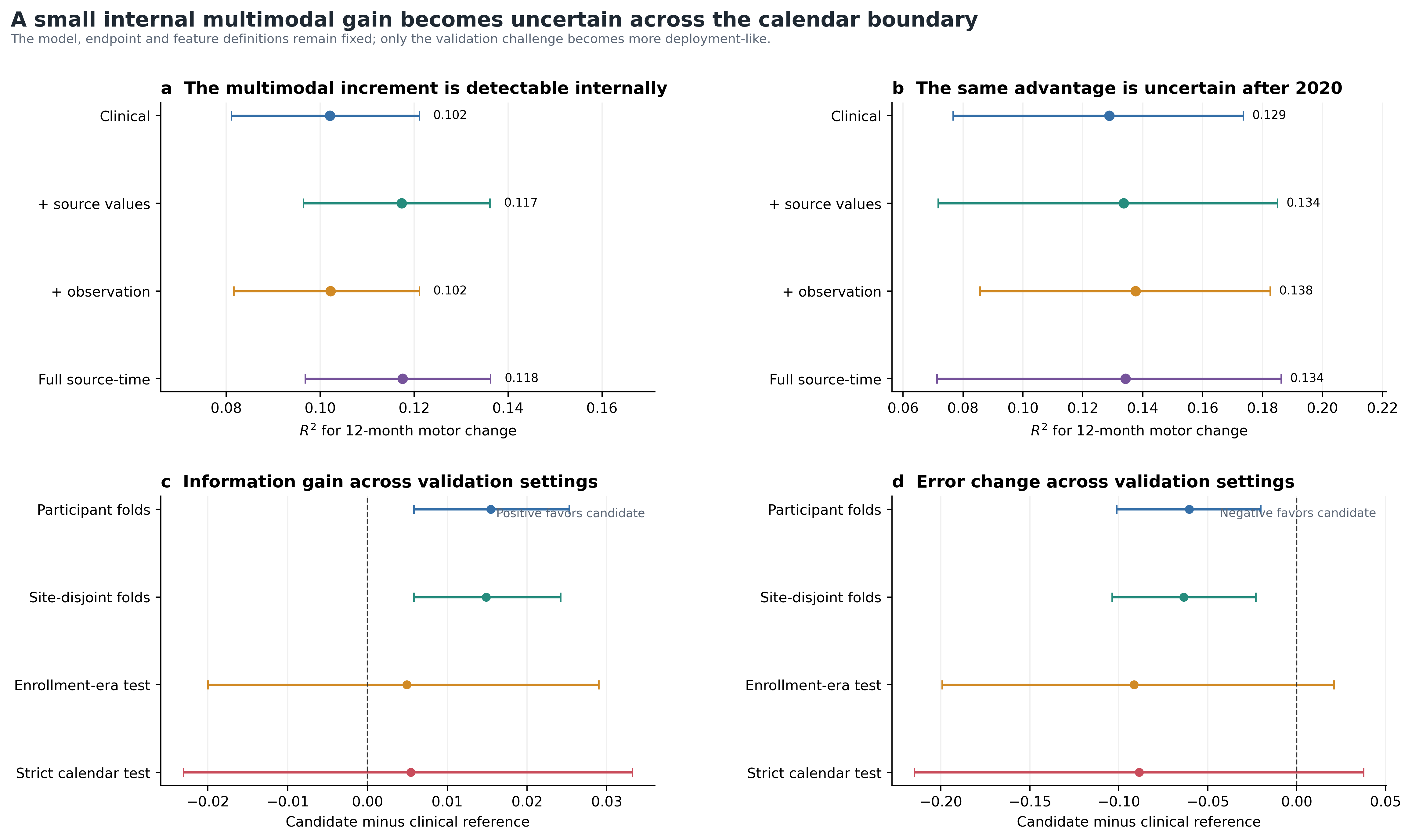
A statistically stable improvement can still be practically negligible. The 0.060 point MAE reduction does not establish individual prognosis, patient-management value, or clinical-trial enrichment.
Uncertainty and stress testing
An interval may cover well and still fail to identify safer predictions
Coverage asks whether the future falls inside an interval. Selective prediction asks a harder question: when the model says it is more certain, is it actually less wrong?
External transport
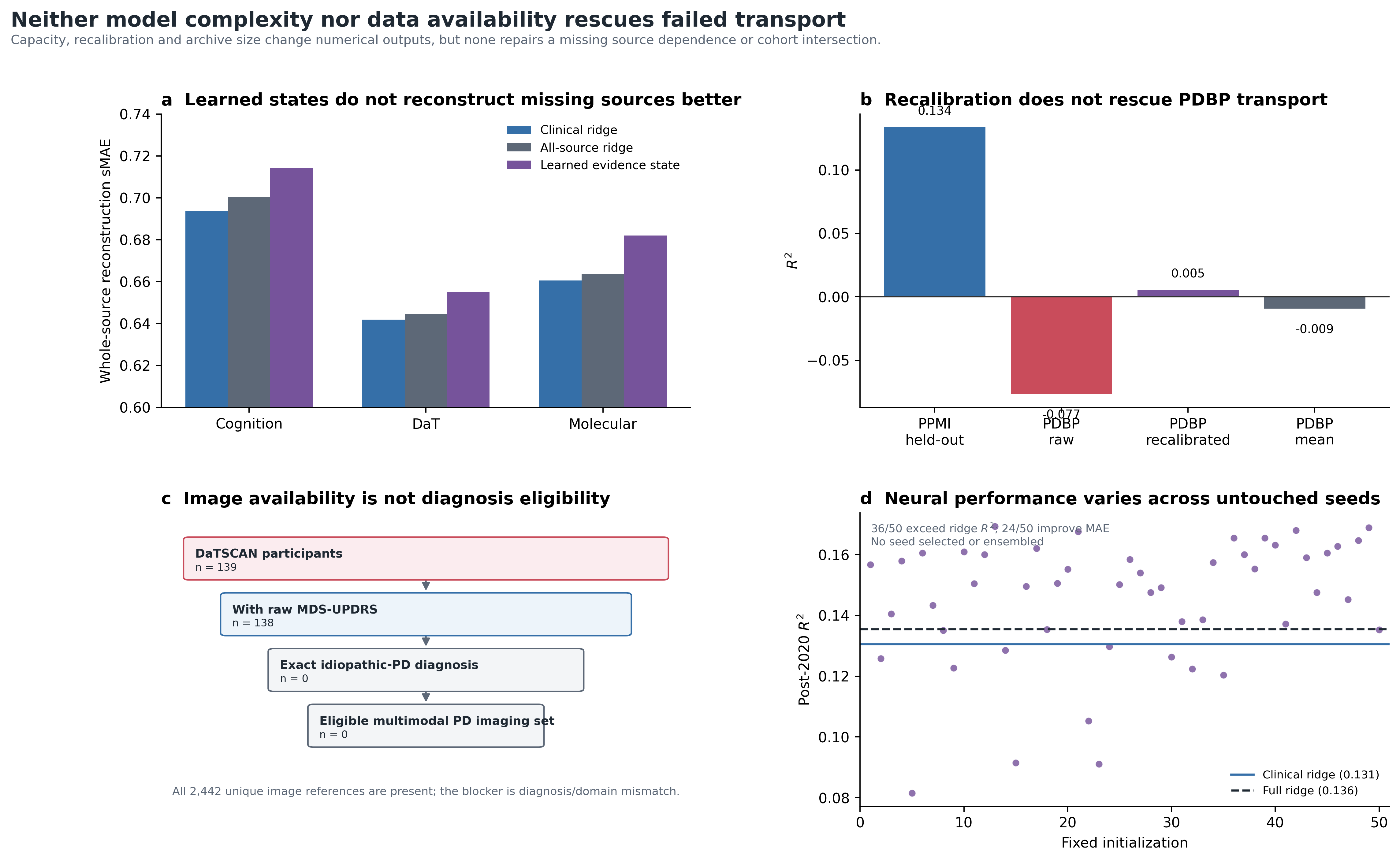
A large archive is not the same as a compatible cohort
PDBP contains valuable Parkinson disease data, but a transport claim requires the same diagnosis, modalities, timing, endpoint, and eligible participants to intersect. File presence alone is not validation.
Claim contract
What the evidence permits us to say
| Gate | Verdict | Permitted statement |
|---|---|---|
| Future-only chronology | Pass | Every predictor precedes its endpoint |
| Participant separation | Pass | The internal signal is not produced by repeated-person leakage |
| Site separation | Pass | A similarly small increment survives a center-held-out challenge |
| Effect magnitude | Information only | Dated sources add an internal increment below promotion magnitude |
| Calendar stability | Fail | Added value is not established across enrollment era |
| Selective uncertainty | Abstain | Coverage is adequate, but uncertainty does not reliably rank error |
| External PDBP transport | Fail | Recalibration and archive size do not establish transport |
What this work contributes
- A future-only rolling-origin patient representation
- Separate people for model fitting, calibration, and testing
- Independent gate verdicts instead of one favorable score
- Executable stopping decisions under null effects, leakage, and shift
What this work does not claim
- Individual clinical prognosis
- Calibrated mechanism probability
- Treatment selection or treatment benefit
- Successful external multimodal validation
Connected research / Different questions, different claims
From patient phenotypes toward mechanism-aware evidence
- 01 / Pathway context
CVC pathway-anchored clustering
Organizes structural, microstructural and dopaminergic imaging by predefined biological pathways.
- 02 / Patient phenotypes
Posterior-aware phenotyping
Addresses clinical heterogeneity and uncertainty in patient representations.
bioRxiv preprint - 03 / Biological specificity
Signed dopaminergic laterality
Retains direction, tests contralateral agreement and preserves unresolved conflict.
- 04 / Validity limits
Longitudinal validity gates
Tests when a patient-state forecast is informative and when its clinical claim must stop.
Our earlier integrated genetic, molecular and wearable-biomarker study (medRxiv preprint) provides complementary multimodal stratification context. It is distinct from CVC's pathway-anchored imaging study.
This is a research progression, not a single jointly validated diagnostic pipeline. Patient-specific intervention simulation and treatment selection remain future work. The AI4PD program provides the broader systems context; these pages replay fixed research examples, not live clinical predictions.
Data: PPMI; access to underlying participant data follows the source study's application process. Code is available from the authors on request; the paper-specific repository is pd-validity-gates (access required). Putamen outlines adapt the NIH 3D Human Reference Atlas "Brain, Male" (3DPX-020960), based on the Allen Human Reference Atlas under CC BY 4.0, rendered here as neutral two-dimensional views. They are not patient scans.